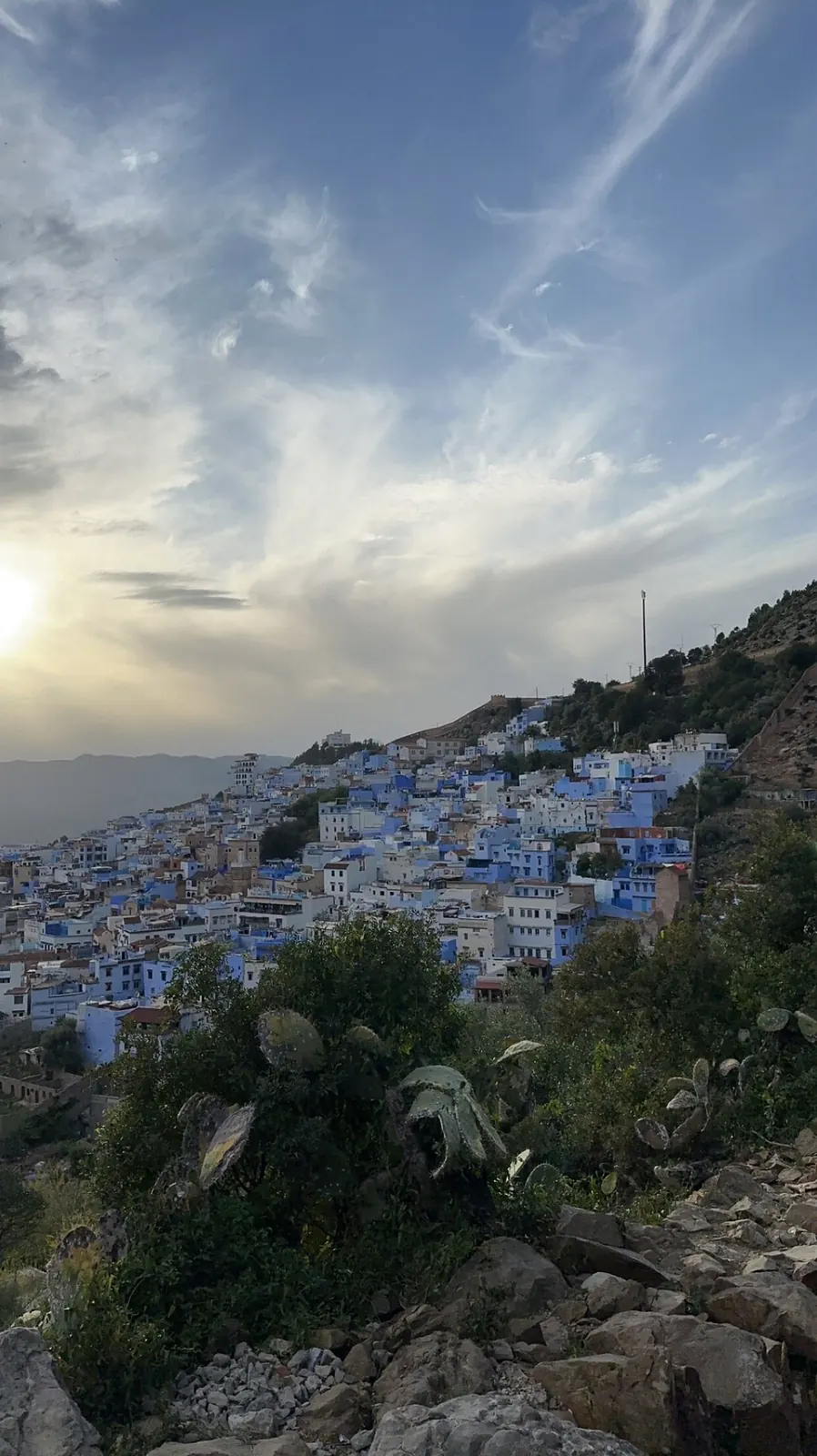
The blue of Chefchaouen is not one colour. At seven in the morning, before the day's light has fully arrived, the alleys run silver-blue — the colour of sea mist, or old pewter. By noon the walls are vivid: cobalt, indigo, the deep blue of Mediterranean tiles catching the sun. At dusk, the light going horizontal, the whole medina turns something close to violet. Most visitors see one version. Staying two nights means you see all three.
The approach to Chefchaouen matters. The road from Fes passes through two and a half hours of cedar forest, terraced hillsides, and mountain villages whose walls are already beginning to pick up the blue. Then the city appears below: a dense cluster of blue-white rooftops in a green valley, the Rif ridgeline rising immediately behind. There is no gradual entry. The medina begins at the gate.
Place Uta el-Hammam, the main square, is where most visitors find their bearings — a fifteenth-century kasbah on one side, an octagonal fountain at the centre that is perpetually in use: old men washing hands before prayer, children circling the basin, pigeons arriving and departing without urgency. In the early morning, before the cafés have opened and the vendors have spread their carpets, the square in its own quiet is the most beautiful version of itself.
The argument for arriving early
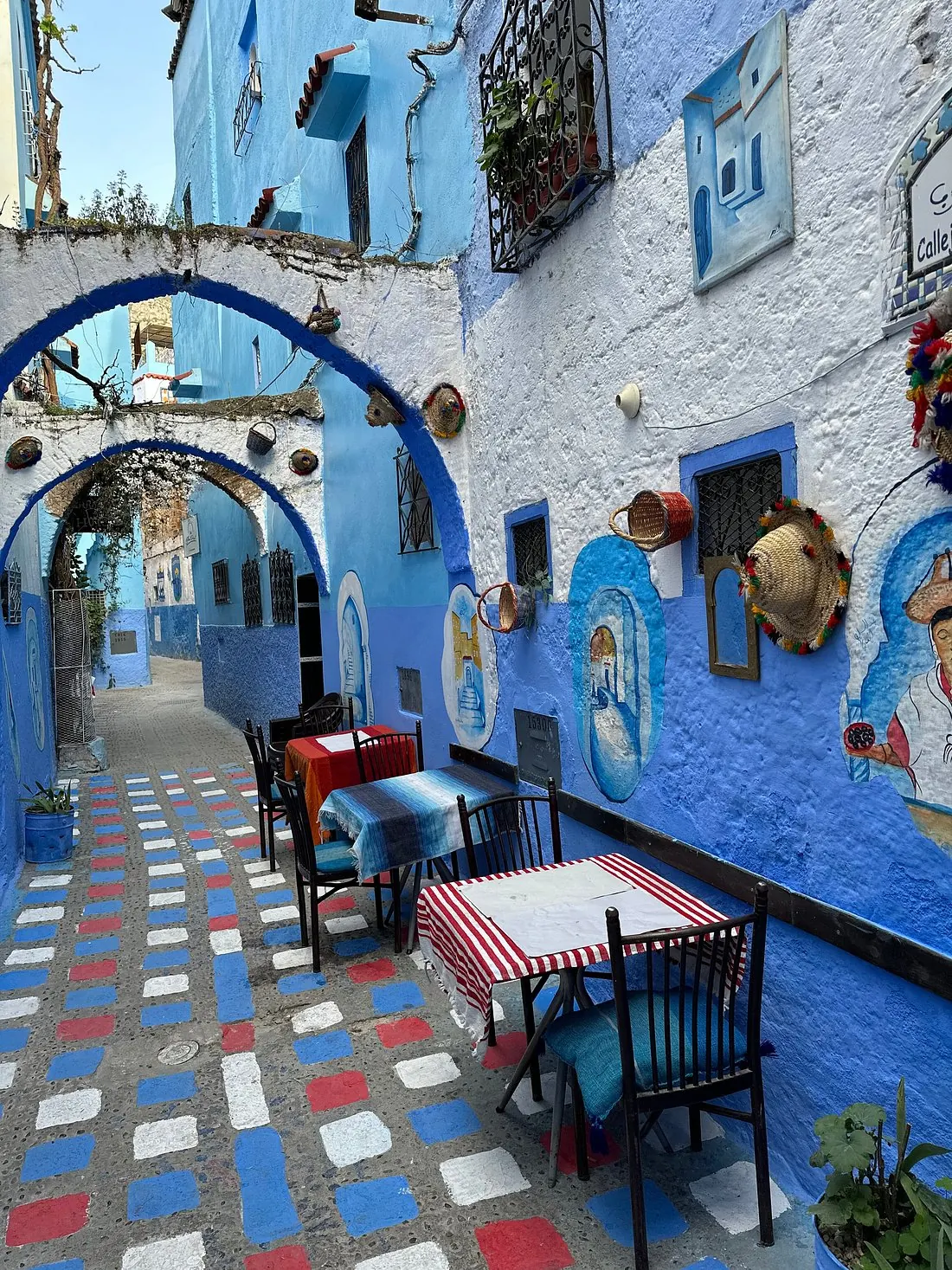
Chefchaouen's most photographed streets — the blue staircases, the arched passages, the alleys that have been shared millions of times on social media — start filling with visitors around ten in the morning. By midday in the busy seasons, moving through them means pausing constantly to let someone finish a photograph. This is not a criticism of those visitors. The impulse is understandable. The city is extraordinary.
But the city at seven in the morning is a different proposition. The bakeries are opening their shutters — you can smell bread before you see it. The cats that occupy every other doorstep are moving slowly in the warming air. The alley leading toward Ras el-Ma — the spring at the top of the medina where cold mountain water runs through stone channels and local women have been washing rugs since long before the tourists arrived — is almost empty. That walk, in the early morning, through streets where the blue has faded over years to a washed-out grey-indigo, is the most honest version of the city.
“Chefchaouen is not a backdrop. It is a living city — and the best moments happen when you stop trying to photograph everything and start noticing what is around you.”
What the blue actually is
People arrive expecting a uniform blue and find instead a continuous variation. Some walls are raw bright cobalt, freshly painted. Others are five-year-old, sun-faded blue-grey. Some alleys trend toward turquoise; others run closer to lavender. The effect is richer for the inconsistency — a city painted not by a single decision but by thousands of small ones, over decades, by landlords and families and, one suspects, whoever felt like it on a given afternoon.
The origins of the blue are honestly contested. One account connects it to the Jewish community that settled here in the 1930s, fleeing persecution in Europe, who may have introduced the tradition of painting walls blue as a reference to the heavens. Another traces it to whitewash practices that evolved, in the damp mountain air, toward pigment. A third — sometimes offered with a smile by locals who have heard all the theories — is that the blue keeps mosquitoes away. What is clear is that the practice predates the tourism by several decades, and would continue after it.
Two walks above the medina
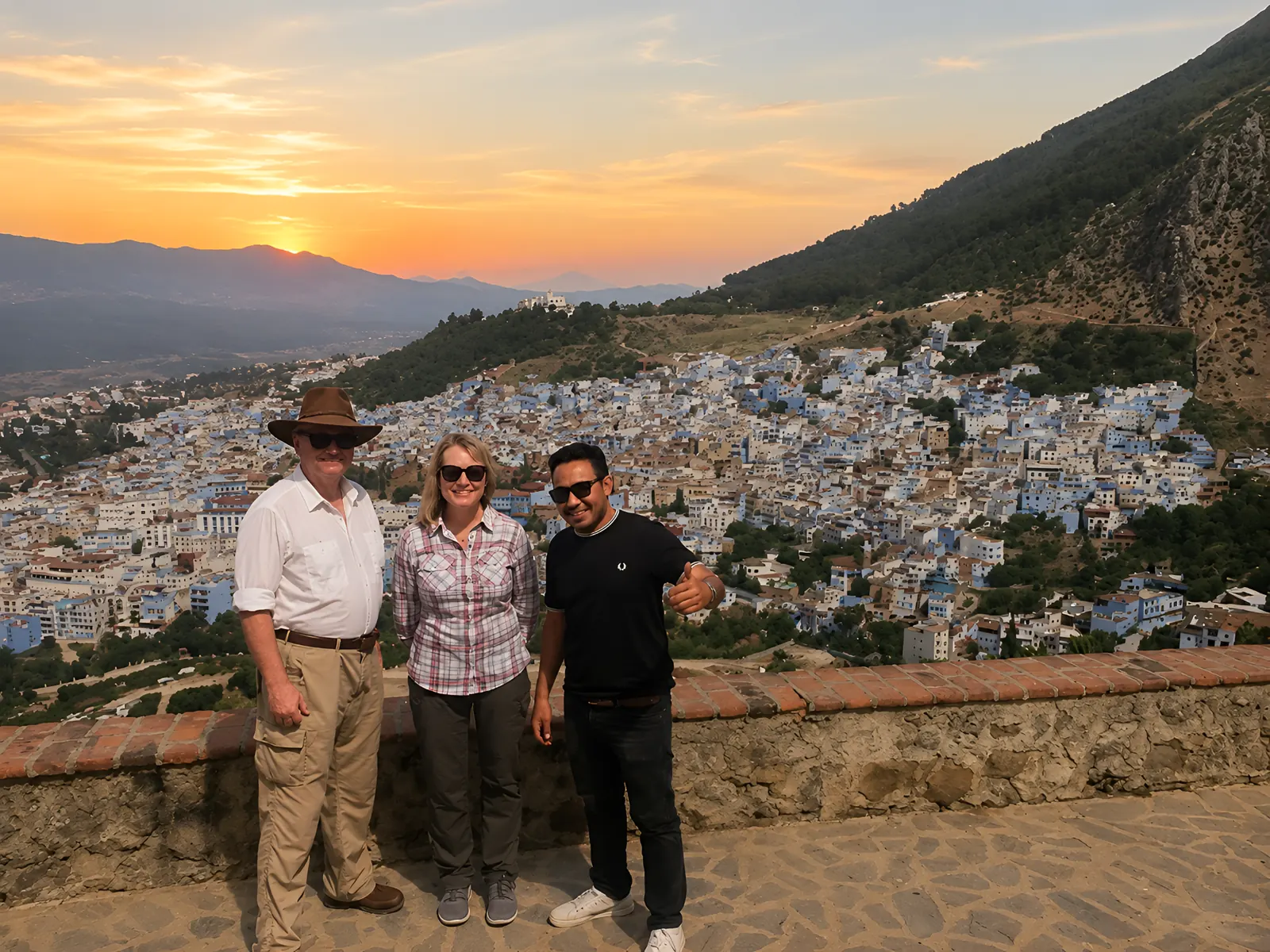
The hike to the Spanish Mosque takes forty-five minutes from the medina entrance, climbing through pine scrub above the city, past small kitchen gardens and a café that appears at exactly the right moment in the ascent. The mosque itself is a modest twentieth-century ruin. The view from it is not modest: the entire medina below, the mountains framing it on three sides, the valley opening to the south. At sunset, when the blue of the city catches the last warm light, it is one of the finer views in northern Morocco.
Ras el-Ma — 'head of water' in the Berber language — is at the opposite end of the medina: shorter to reach, easier to miss. The spring emerges from the mountain at the end of a lane that most visitors do not follow to its end. The water is cold and clear even in August. Families doing laundry in the channels beside it have been doing this particular thing for generations. It is not a spectacle. It is simply what the city is when the photography stops.
An hour beyond the city: Akchour
An hour's drive from Chefchaouen, in Talassemtane National Park, the Akchour trail runs through a limestone gorge of slowly building drama. The path follows a river into an increasingly narrow canyon — the walls rise, the light narrows — and after about two hours of walking on a good path, the gorge opens into a series of pools fed by a cascade of about a hundred metres. The water is a cold, clear green, swimmable from May through September. Very few visitors who come to Chefchaouen extend their stay to include this day. The ones who do find it a different piece of Morocco entirely.
The character of the place
Chefchaouen has a different character from the great imperial cities of the south. It is a small city: the medina can be walked across in twenty minutes. It is cooler — positioned at six hundred metres in the mountains, it stays ten degrees below Marrakech through the hottest summer weeks. It is, despite its global photographic fame, still a working community. The man selling argan oil on the square is the same person who was there fifteen years ago. The restaurant on the corner that makes the best harira in the city has no website.
The influence of the Spanish Reconquista is still visible here — the Andalusian refugees who settled in this part of Morocco in the fifteenth and sixteenth centuries left an architecture, a culinary tradition, and a pace that feels Mediterranean rather than Saharan. The food reflects this: more fresh herbs, more goat products, a lighter hand with the preserved lemons that define southern Moroccan cooking. The local goat cheese, sold in the market wrapped in palm leaves, is one of the distinctive flavours of the north.
- Stay at least two nights. A day trip from Fes gives you one version of the medina — the daytime, crowded version. Two nights give you the morning and the evening too.
- Walk to the Spanish Mosque for sunset. Allow 45 minutes each way and more time at the top. Take a layer — it cools quickly after the light goes.
- Find Ras el-Ma in the early morning, before the day organises itself around you.
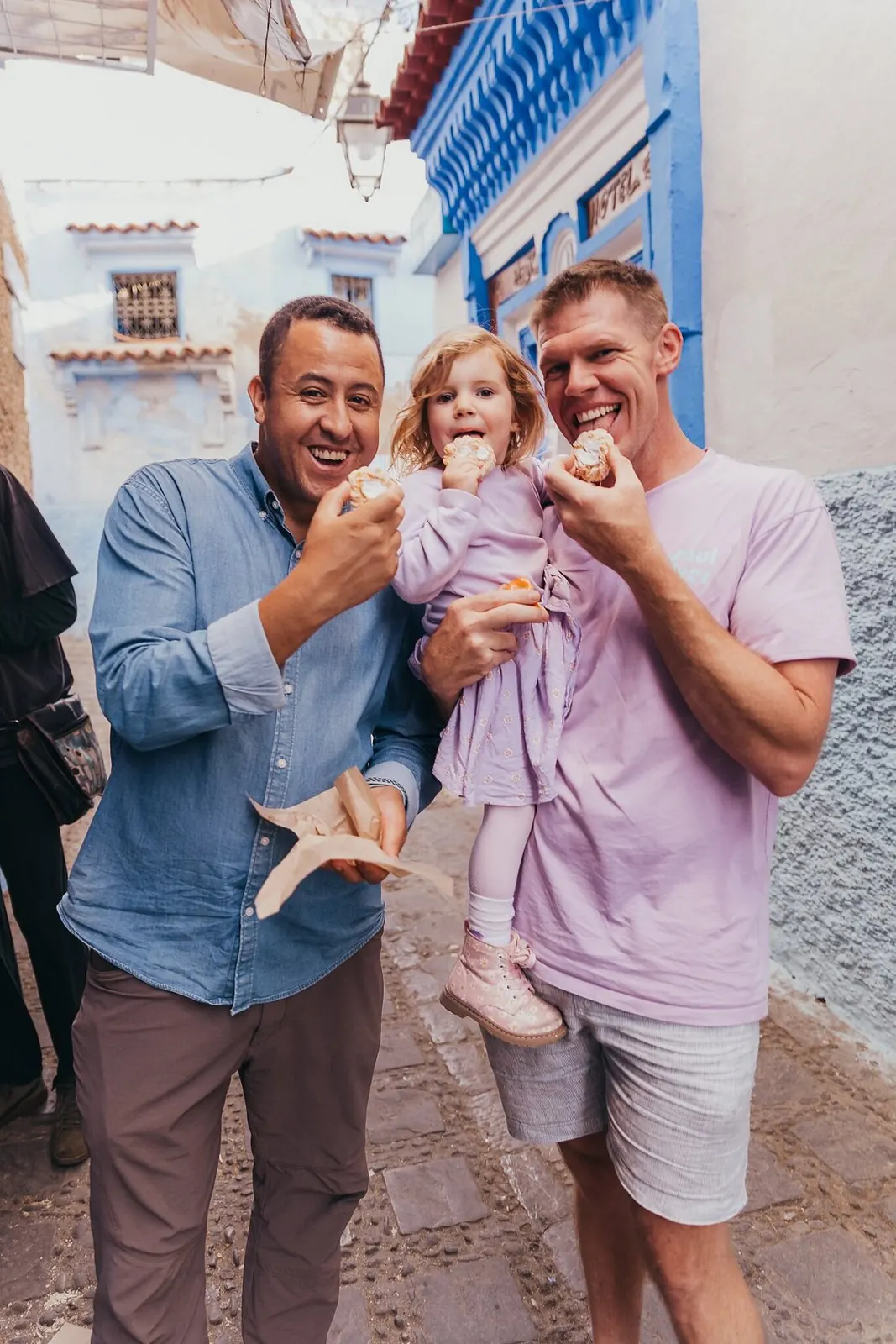
- Try the local goat cheese. It is sold in the market square in rounds wrapped in palm leaves. The Rif produces the finest in Morocco.
- The Akchour gorge is worth a full day. Bring a picnic and shoes that can get wet.
- The kasbah in Place Uta el-Hammam has a small ethnographic museum and a walled garden that almost no one visits. Go there.
Our two-day Chefchaouen journey is built around these rhythms: a riad in the medina, an early morning guided walk through the less-visited streets, and an afternoon with nothing scheduled. The afternoon is where Chefchaouen gives you what the morning cannot — the feeling of having arrived somewhere rather than simply passed through it.
For travellers making the northern circuit — Fes, the Rif Mountains, the Mediterranean coast, and back — Chefchaouen sits at the quiet centre of a longer story. A city that asks less of you than the others, and gives more.
Chefchaouen is about four hours from Fes and five from Casablanca. Visit it on our 2 day Chefchaouen tour from Casablanca or as part of the 9 day Morocco tour, and check the best time to visit Morocco before you book.