The expectation gap is real. People imagine one of two things: the Instagram version — a pool rising improbably from the sand, Bali-style daybeds on the dunes, service in white gloves — or the other thing, the boy-scout version, with sleeping bags on the ground and a flashlight wedged in the sand. The reality of a well-run luxury desert camp is different from both. And, for most travellers, considerably better than either.
I have stayed in the Sahara camps around Erg Chebbi hundreds of times over the years — initially as a guide sleeping in whatever accommodation the camp offered, more recently in the specific camps we use for our guests, where I know the owners personally and have watched the quality evolve. What follows is what I would tell a close friend before they spent their first night in the desert.
What the tent actually is
It is not a camping tent. Let me say that clearly, because the word 'tent' carries the wrong associations. A properly designed desert camp tent is a structure: a frame of wood or metal supporting heavy canvas walls, with a proper wooden floor, insulated against both the heat of the day and the cold of the night. Inside, you will find a real bed — a frame, a thick mattress, quality cotton linens, pillows. Not a cot. A bed that you would sleep well in at home.
The bathroom is private and attached to your tent. A small ensuite with a toilet, basin, and shower. The water pressure will not be what you are used to in a city hotel. The shower runs hot because the water tank on the roof of the bathroom structure has been heating in the sun since morning. It is simple, functional, and clean.
In the cooler months — October through March — the better camps have electric heating in the tents, running off a generator that operates in the evenings. In summer, the tents are equipped with fans, and in some camps, air conditioning. The desert temperature swing is dramatic: forty degrees at four in the afternoon can become eight degrees at three in the morning. The camp is built for this.
Arriving
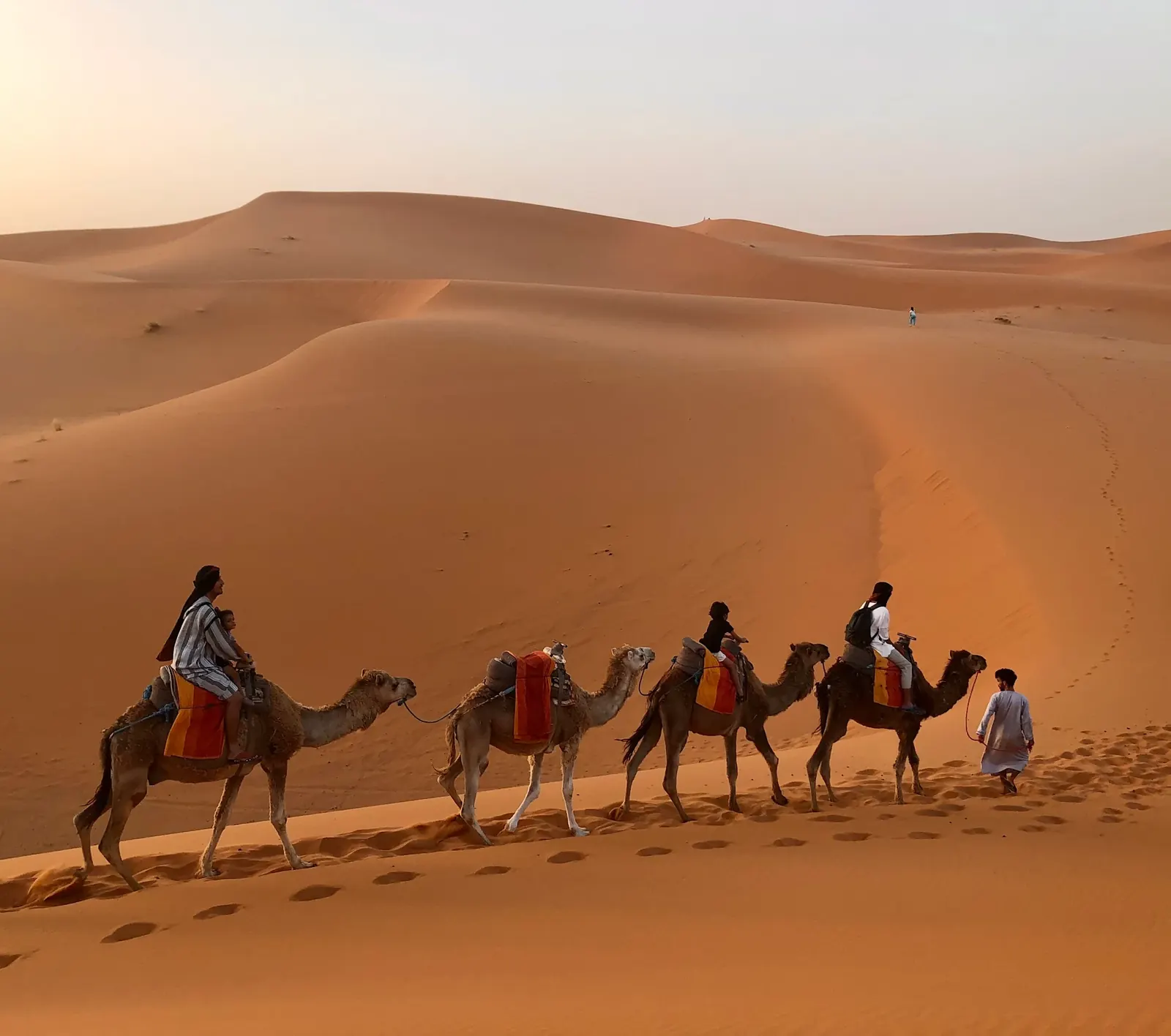
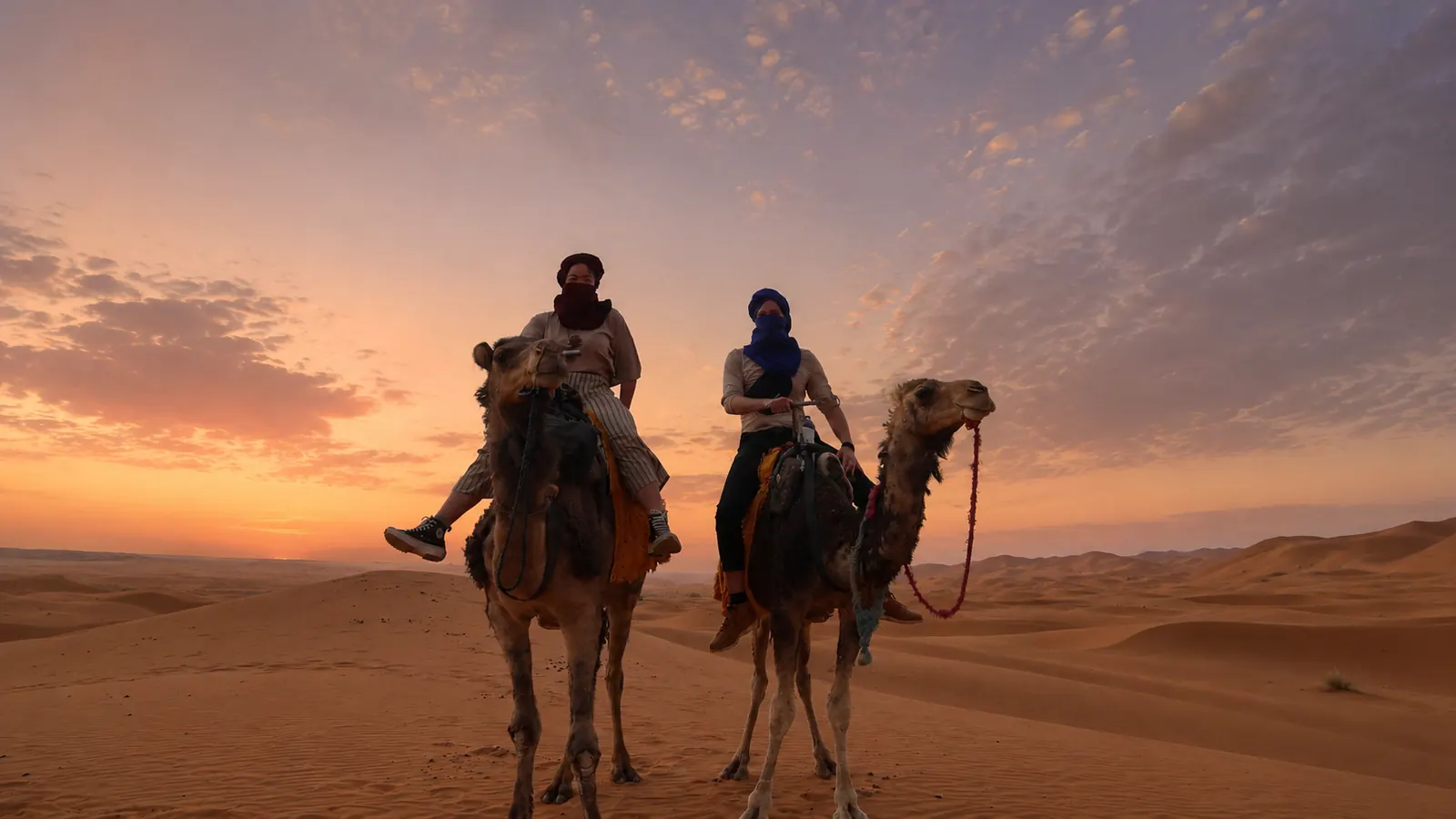
We arrive at the edge of the dunes in the late afternoon — deliberately so. The heat has passed. The dunes have turned from pale gold to amber. You leave most of your bags at the camp's front area or in the vehicle, take a small bag for the night, and mount your camel.
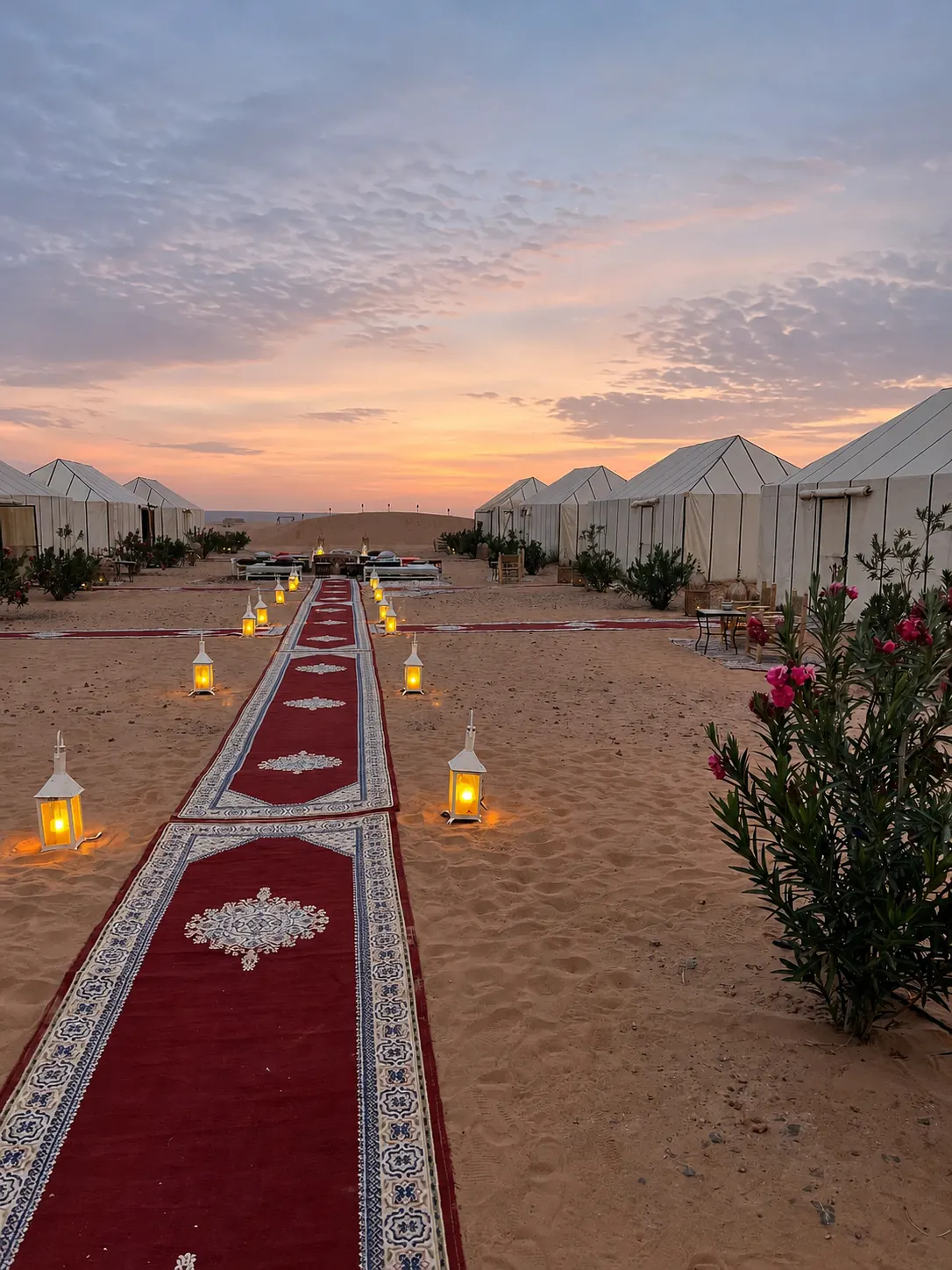
The camel trek into the dunes takes between thirty and fifty minutes depending on the camp's position. By the time you arrive, the staff have lit the lanterns along the pathway between the tents. Someone brings mint tea while you leave your bag in the tent and change into something loose. The temperature is already softening. The dunes are close — you can walk to the nearest ridge in five minutes.
There is a moment, usually just after the tea and just before dinner is announced, when the camp falls quiet. The wind drops. The last colour leaves the sky. People stop moving and stand there. This is why people come.
Dinner in the desert
Dinner is served communally — a long table, or cushioned seating around low tables arranged near the fire, depending on the camp. The food is cooked on site: tagine in clay pots over charcoal, bread baked in the sand beneath the embers, salads, harira soup, fresh fruit. It is not restaurant food and it is not trying to be. It is the right food for the moment — warm, simple, full of spice.
Mint tea comes at the end of dinner, poured from height in the traditional way. Then the fire grows, and the musicians begin.
The music and the fire
The musicians at the desert camp play Berber music — gnawa rhythms, desert folk songs, the guembri (a three-stringed bass lute whose sound is somewhere between a bass guitar and a double bass), hand drums, metal castanets. The music is intended for the fire circle, not a concert hall. It sounds right out here in a way that it does not sound right anywhere else.
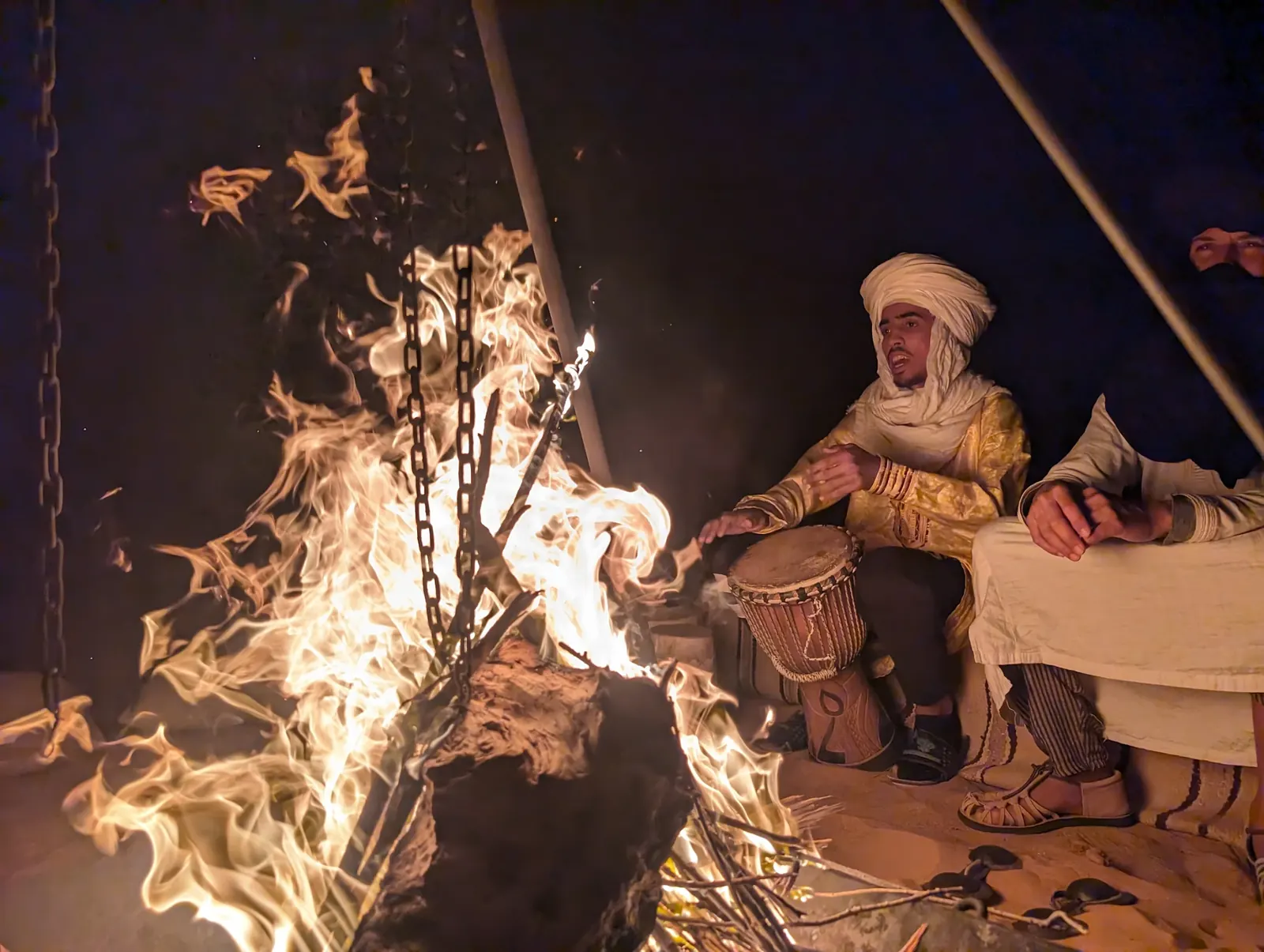
The fire is large and real. The desert gets cold after midnight and the fire is the social and thermal centre of the evening. People stay around it as long as they want to. Some go to bed at ten. Some sit until the musicians put down their instruments, which can be midnight or later.
“No one has ever asked me, the morning after a night in the desert, whether the camp had good wi-fi. But people ask me, regularly, how they can stay longer.”
The night sky
The Erg Chebbi area sits in a vast, sparsely populated region of southern Morocco. There are no cities within 150 kilometres and very little artificial light. The result — on a clear night, which is most nights — is a sky that is unfamiliar to most people who have spent their lives in or near cities.
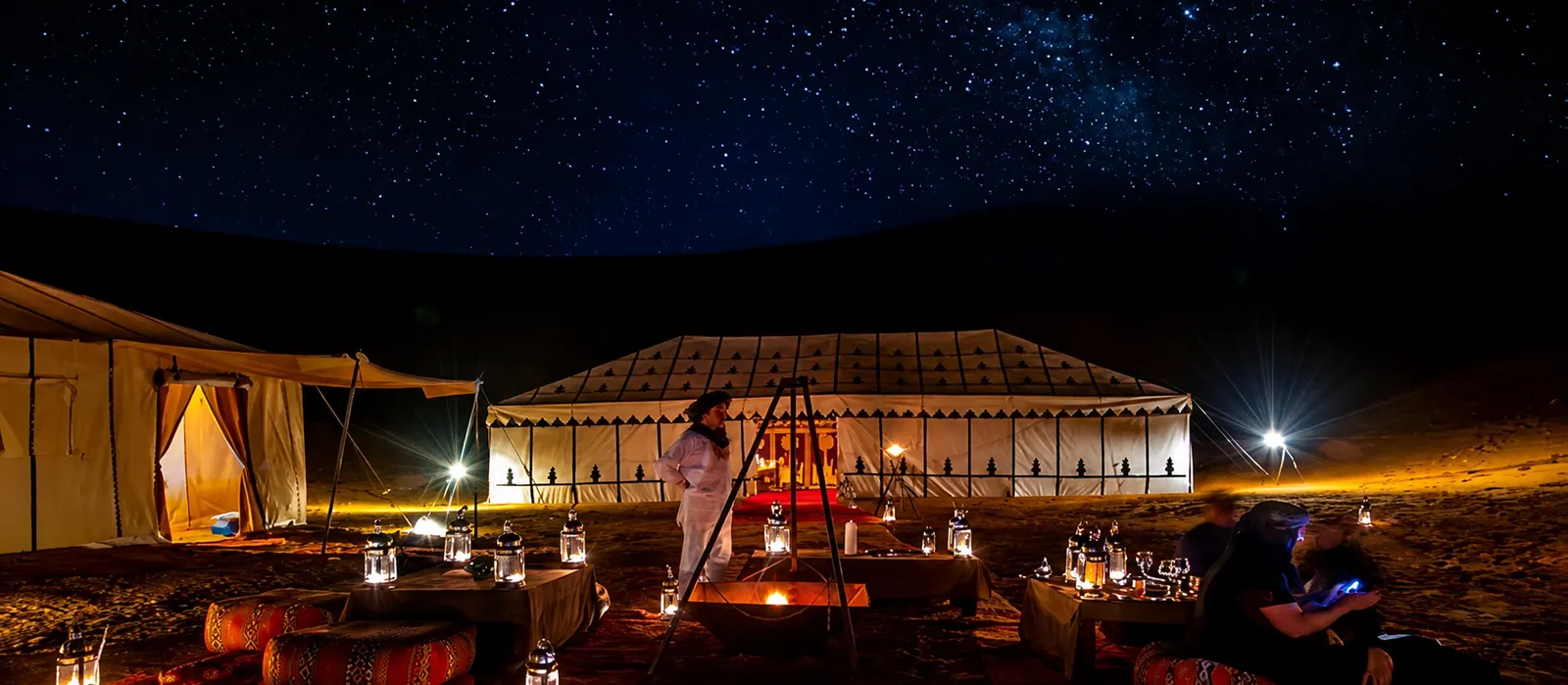
The Milky Way is visible with the naked eye. Not as a faint band but as a vivid, textured arc across the full width of the sky. In winter it rises over the eastern dunes around ten in the evening. In the cleaner air of October and November, at higher elevation than the valley floor, the density of stars is enough to cast faint shadows.
The best way to see it is to walk away from the camp until the lanterns are small behind you, and then stop and look up. Allow your eyes twenty minutes to adjust. Then stop moving.
The cold: what to expect
If you are visiting in the shoulder seasons or winter — which are the best seasons for the desert — the nights will be cold. In January, two in the morning in the open desert can reach zero degrees. In October, it sits around eight or ten degrees after midnight. The camp is insulated and heated. The beds have enough blankets. But the walk from your tent to the dune and back will require a layer.
Bring: a fleece or down jacket that compresses into your day bag. Closed shoes for the night walk — not sandals. Wool socks. The camp provides additional blankets if you ask. We always tell guests before they pack: the desert cold is drier and more manageable than it sounds, but it is real, and the people who are warm are the people who came prepared for it.
The morning: why we wake everyone early
We knock on the tent at five in the morning. Some guests — understandably — are not delighted by this. None have ever said, afterwards, that they wished we had let them sleep.
The walk up the dune in darkness is disorienting in the best way: you cannot see the scale of what surrounds you. The sand is cold underfoot. The stars are still bright. You climb by feel, your feet finding the crest of the ridge, and then you sit down and wait.
The light comes slowly. The eastern ridgeline turns pink first. Then gold. Then the full amber of the dunes catches the sun in stages, warming from the top down, the shadow retreating across the sand until the whole desert is lit and warm and impossibly beautiful. Twenty minutes from first light to full sunrise. Those twenty minutes are the reason people tell us, years later, that the Sahara was the most beautiful thing they have seen.
What you don't need to think about
Water is provided in the camp — both drinking water and shower water. You do not need to bring supplies beyond what you want for the night: a book, a journal, the jacket. Your main bags wait in the vehicle or at the camp's front storage area.
Mobile signal is variable. Some parts of the dunes have a weak 4G signal; most do not. This is, in our experience, the feature people appreciate most in retrospect. It is worth accepting in advance and leaving your expectations about connectivity at the edge of the sand.
What distinguishes camps from each other
The quality range is wide. At one end: basic tents with shared bathrooms, thin mattresses, no heating, meals from a box. At the other: well-made structures with proper beds, ensuite bathrooms, fresh food cooked daily, experienced musicians, a camp positioned for an unobstructed horizon rather than squeezed between six other camps.
The differences that matter most are not the amenities. They are the positioning — whether the camp has a genuine view of open dunes or is surrounded by neighbouring camps — and the food. A camp that cooks properly signals that everything else has been thought about. A camp with a reheated meal from a canteen suggests that the details were not the priority.
We have vetted the camps we use personally. On our desert tours, you will not arrive to find the view is of a car park. We know which ridge the best sunset falls on and we make sure you are positioned for it.
“The Sahara is patient with the people who give it their full attention. The camp is just where you sleep. The desert is where the experience happens.”
Getting there takes planning: read our Marrakech to Merzouga route guide and our desert packing list, then choose between the 3 day and 4 day desert tour from Marrakech.