Seven days is not enough to understand Morocco. But it is enough to fall in love with it — which may be the more useful thing.
The question of how long to spend in Morocco is one I think about often, because the answer changes depending on what someone actually wants. Five days in Marrakech is a very different kind of trip from five days driving south. Ten days done well is transformative. Ten days done poorly — too fast, too much, too many tourist checkboxes — leaves people exhausted rather than moved.
Seven days, in my experience, is the sweet spot. It is enough time to let the country land properly — to not feel rushed through each place, to spend a full day in the desert rather than a frantic few hours, to arrive in Fes without already thinking about where you need to be next. What follows is the route I would design for someone spending a week in Morocco for the first time, approaching it seriously.
The route in outline
Marrakech → High Atlas Mountains → Aït Ben Haddou → Dadès Gorge → Merzouga (Erg Chebbi) → Todra Gorge → return to Marrakech. The circuit covers roughly 1,400 kilometres. We drive it comfortably in private transportation, with stops that are worth stopping for.
“The south of Morocco — the route from Marrakech into the desert and back — contains more landscape variety per kilometre than almost anywhere else I have driven. You cross a mountain range, pass through ancient river valleys, arrive at a cinematic kasbah, and end at one of the world's great sand seas. In a week.”
Day 1: Arriving in Marrakech
Arrive, drop your bags, and go directly to the medina. Not tomorrow — today, now, before jet lag or fatigue or the riad's comfortable sofas catch you. The medina is best experienced with some bewilderment intact: before you have a map, before you have bearings. The disorientation is part of what it is.
Djemaa el Fna in the early evening is the proper introduction. The square is at its most alive between seven and nine: storytellers and musicians and food vendors and the smell of grilled meat and cumin and smoke. Eat from the stalls — the food is fresh, the experience irreplaceable. Walk back through the souks as they begin to close.
Sleep in the medina. A good riad — a traditional Moroccan home built around a courtyard — will be your first proper encounter with Moroccan design: the tilework, the carved plaster, the lanterns, the quiet that descends at midnight even in the middle of a city of a million people. It is an excellent night's sleep.
Day 2: Marrakech in depth
Rise early and walk the souks before the crowds arrive. At seven in the morning, the leather workers and spice merchants are already at work, the light is low and oblique, and the city belongs to itself rather than to tourism. This is the Marrakech worth knowing.
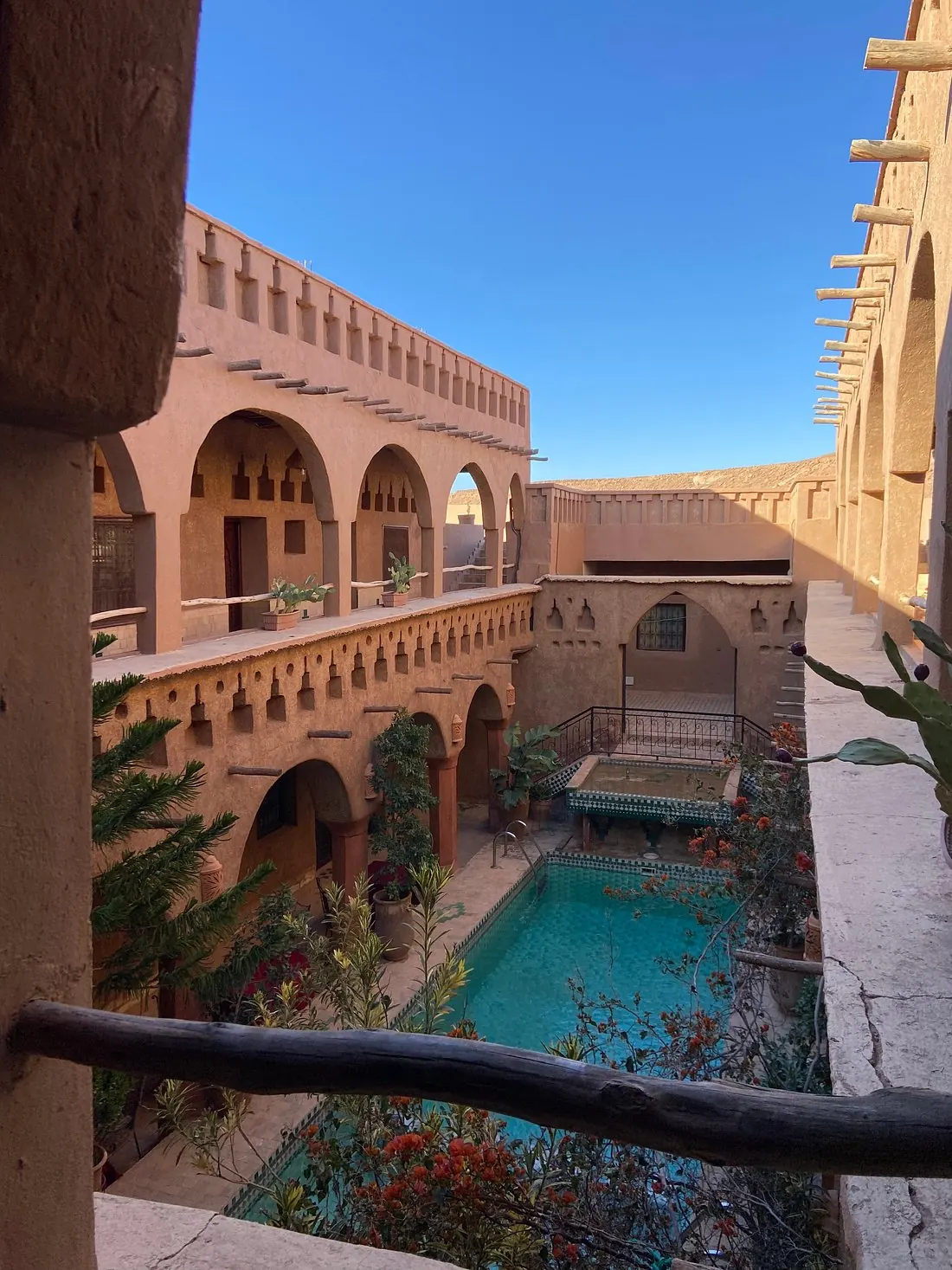
The afternoon belongs to the Ben Youssef Madrasa — a fourteenth-century Quranic school whose courtyard is one of the finest pieces of Islamic architecture in North Africa — and the Bahia Palace, which rewards slow wandering. Avoid both in the middle of the day; the crowds at peak hours diminish the experience.
Book a hammam for late afternoon. An authentic Moroccan steam bath — not the spa version, but the old bathhouse in the medina — is a genuine encounter with the city's daily life. Arrive with guidance; without it, the experience can be confusing and the quality varies wildly.
Dinner on a medina rooftop, watching the sunset turn the minarets gold. Then an early night — tomorrow's drive over the Atlas starts before eight.
Day 3: Over the High Atlas to Aït Ben Haddou
The road south of Marrakech begins to climb almost immediately. Within forty minutes of leaving the city, you are in the Atlas foothills — almond orchards and Berber villages and the road beginning to narrow as it follows the Oued Rheraya upward. The Tizi n'Tichka pass, at 2,260 metres, is the highest paved road in North Africa.
We stop at the pass. Not for a photograph, though photographs happen — but because this is where the landscape changes completely. On the Marrakech side: green valleys, cedar and oak, the Mediterranean Morocco of high altitude. On the southern side, almost immediately: the arid, ochre, monumental landscape of the pre-Sahara begins.
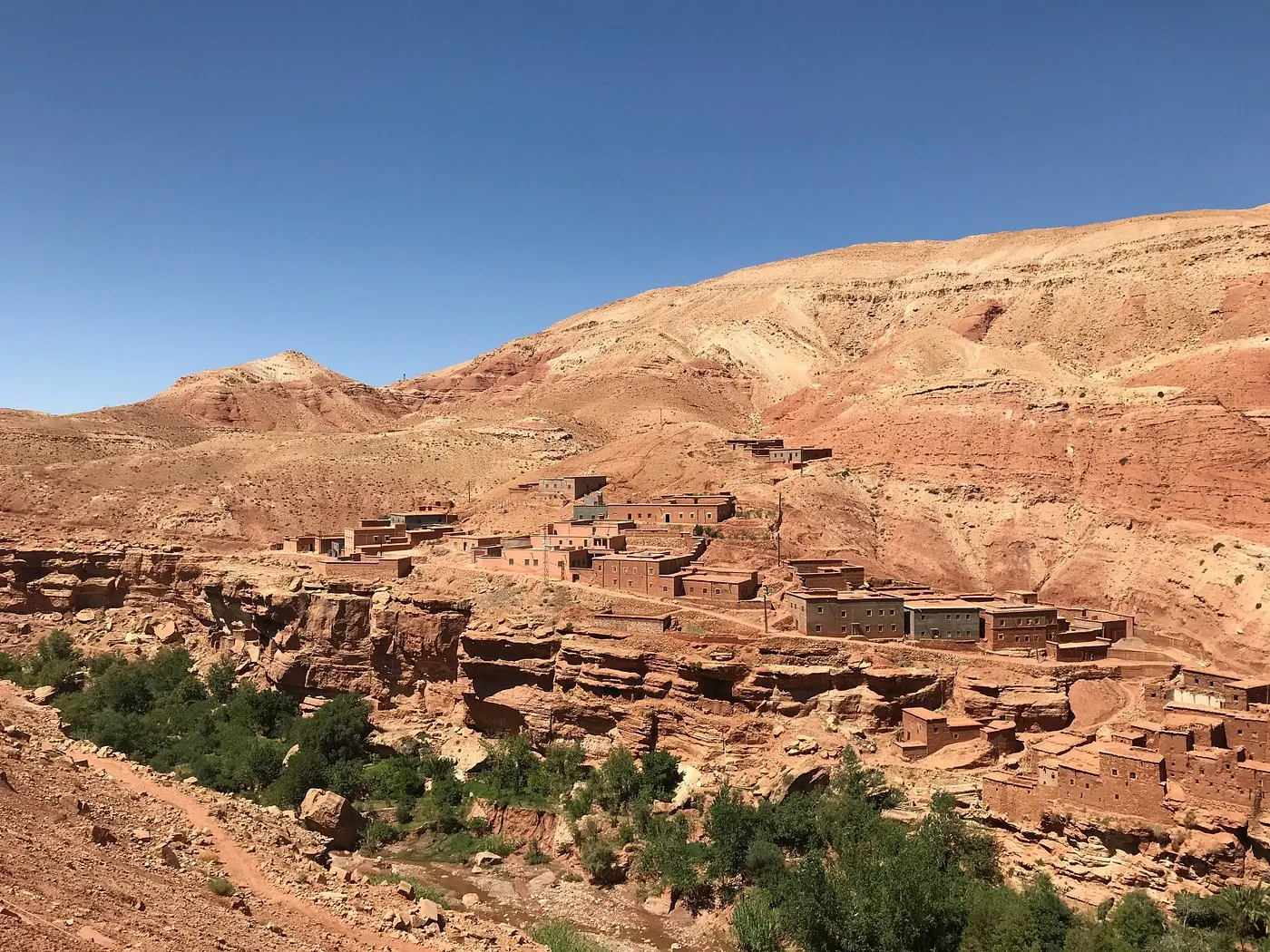
Aït Ben Haddou in the late afternoon light is extraordinary. The ksar — the ancient fortified village on the hillside — is a UNESCO World Heritage site and the most recognisable landscape in Moroccan cinema (Lawrence of Arabia, Gladiator, Game of Thrones all filmed here). What photographs rarely capture is the silence of the surrounding valley, the width of the dried riverbed, the feeling of scale. Walk to the top of the ksar in the last light.
Stay at a small guesthouse near Ouarzazate, ten minutes beyond Aït Ben Haddou. The town itself is calm and unhurried — the 'Hollywood of Africa,' home to the world's largest film studios, which you can visit in the morning if you want a brief curiosity before heading east.
Day 4: The Dadès to the edge of the Sahara
This is the most visually varied driving day of the week. The Route of a Thousand Kasbahs — the N10 east from Ouarzazate — passes through the Dadès Valley, the Rose Valley (in bloom in late April and early May), the village of Boumalne, the entrance to the Dadès Gorge, and eventually the flat southern plain toward Merzouga.
We stop at the Dadès Gorge. The road through the gorge is one of the most dramatic mountain drives in Morocco — a narrow two-lane road that climbs through switchbacks as the canyon walls rise on both sides, eventually reaching small Berber villages perched on ledges above the valley floor. We have lunch at one of these villages. The tagine is cooked over open wood fire.

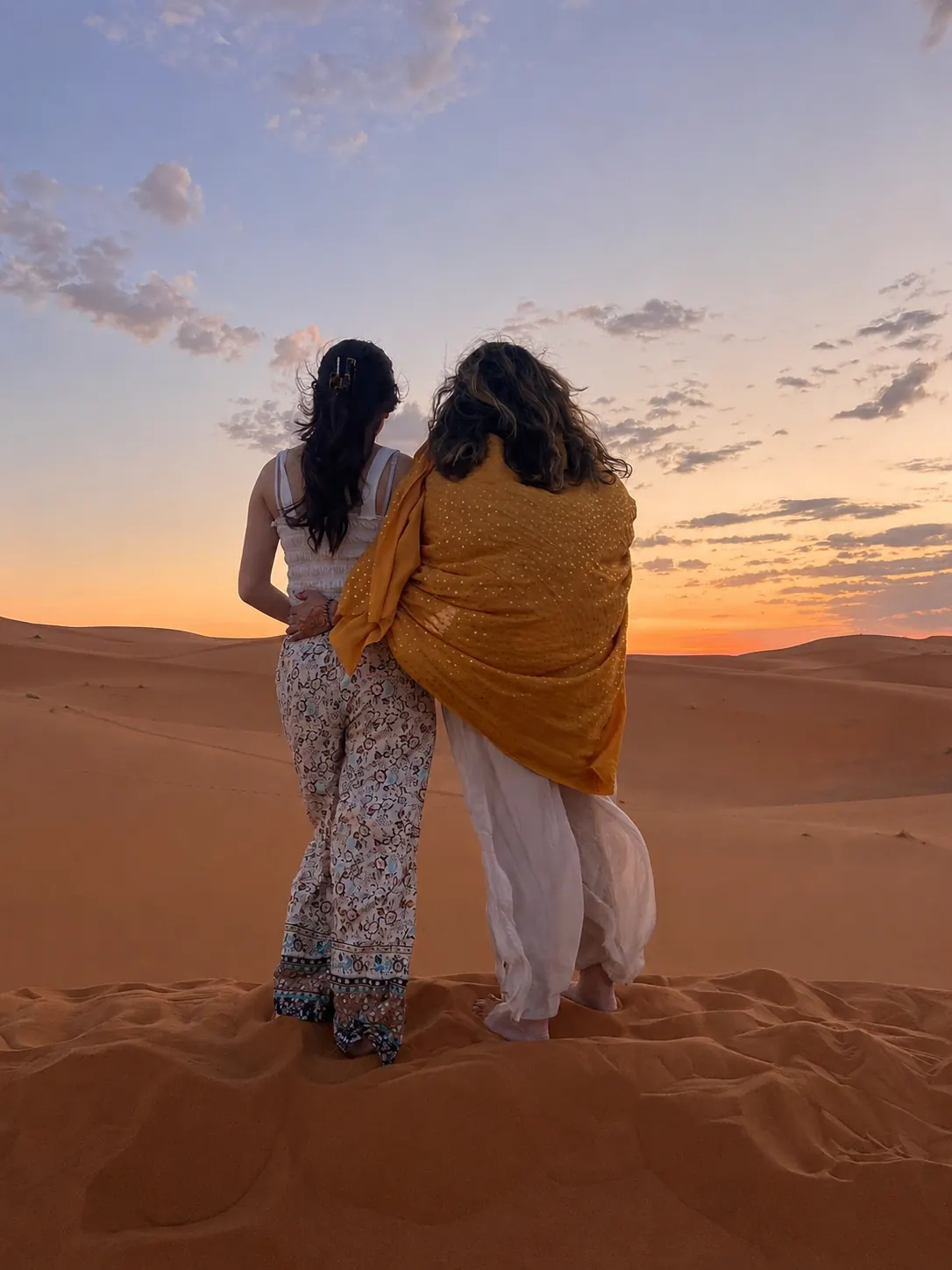
By mid-afternoon you are back on the plain, heading southeast. The landscape becomes progressively more austere: less vegetation, more stone, the horizon perfectly flat. And then — usually around four in the afternoon, as the light is beginning to angle — the dunes appear. Not gradually. All at once. The road turns and Erg Chebbi is simply there, rising from the flat plain like a mirage that has decided to be real.
Day 5: Full day in the Sahara
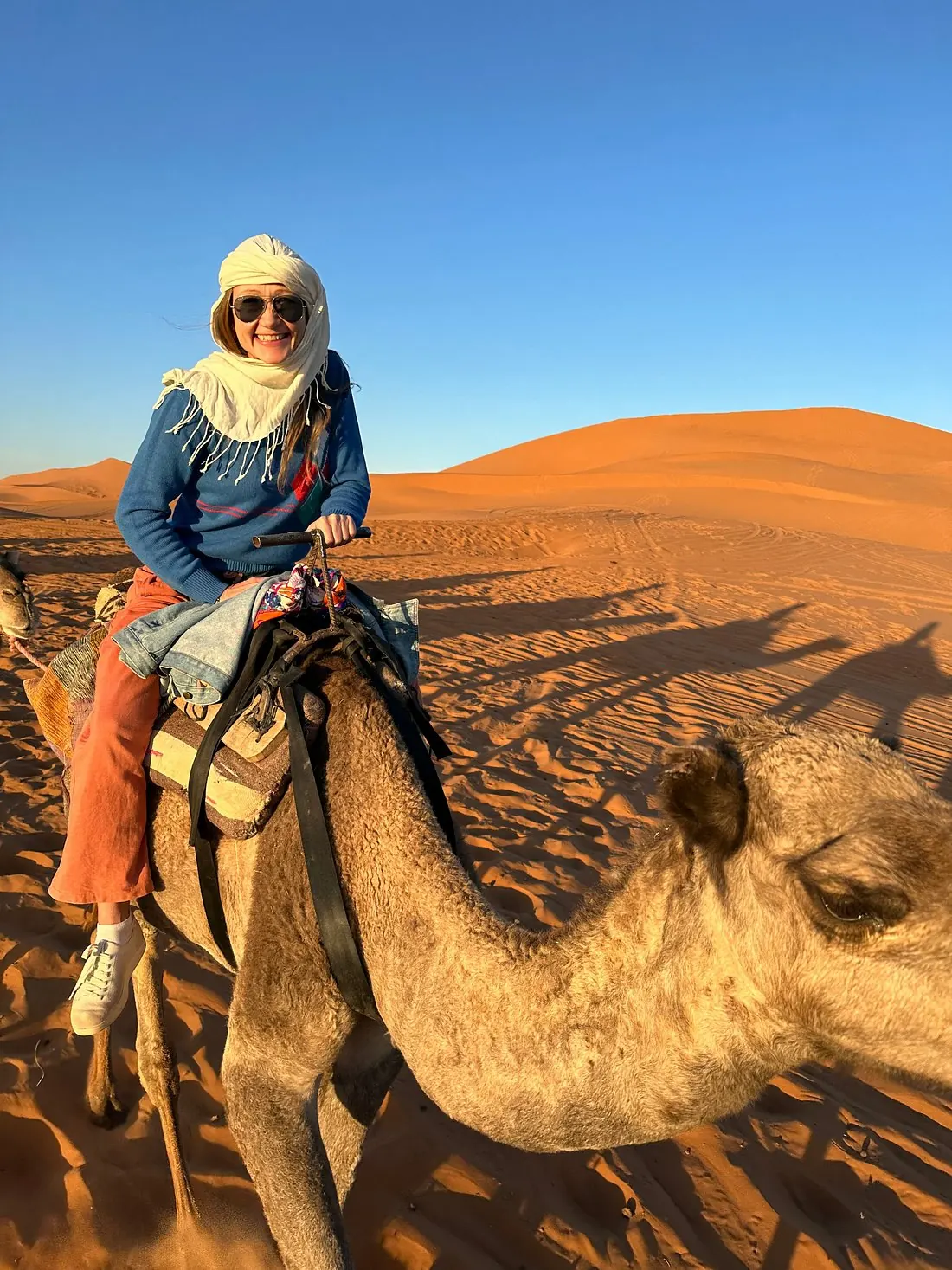
The camel trek the previous evening brought you into the desert. This morning, you woke before sunrise and saw the light come across the dunes. Now you have the full day.
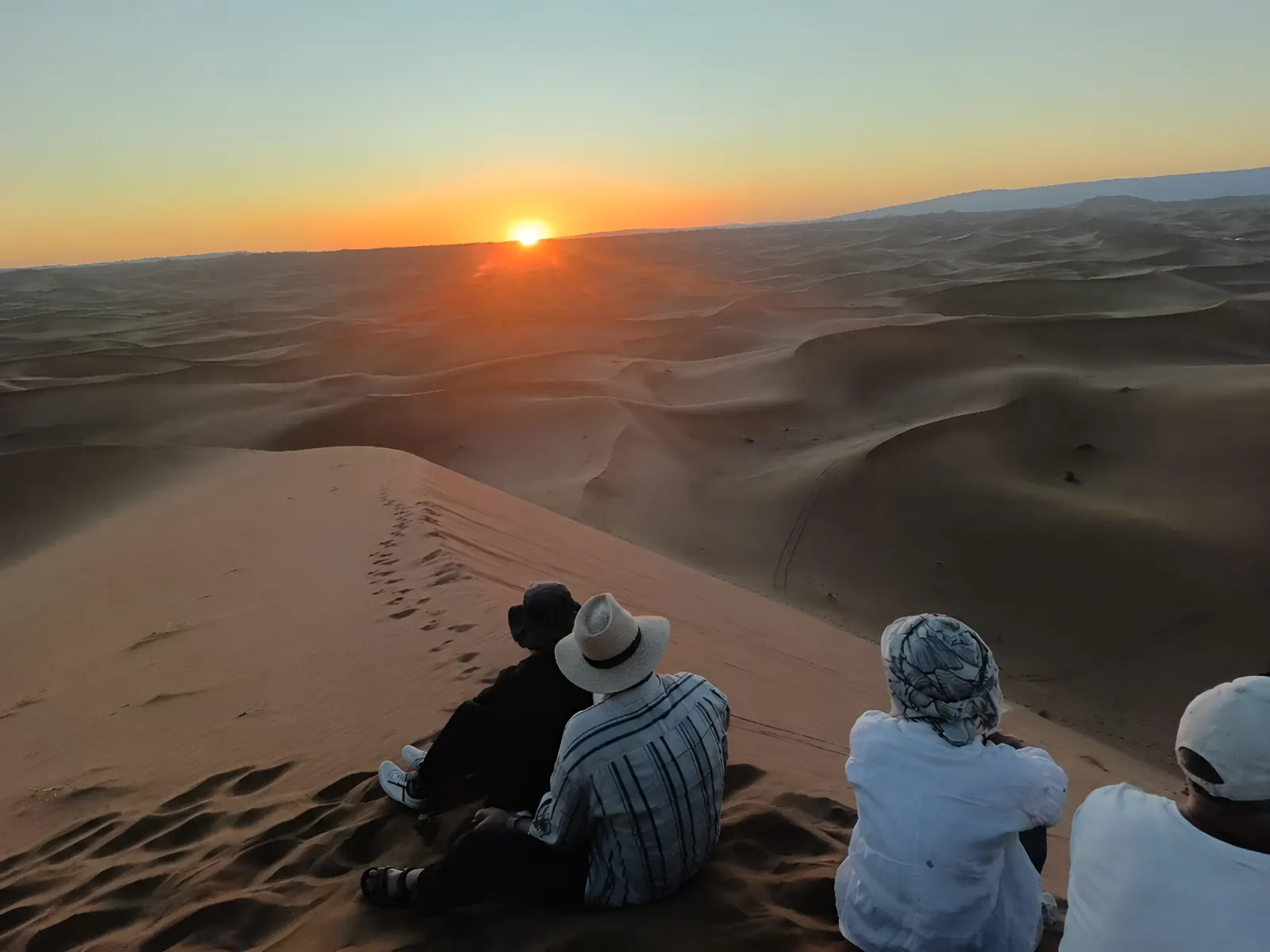
There is no schedule for a full day in the Sahara. This is deliberate. Some travellers want to walk the dune ridgelines for hours. Some want to return to the camp, drink tea, and read in the shade of their tent. Some want to walk to Khamlia, the village of Gnawa musicians, and spend an afternoon listening to music that arrived in the Sahara via sub-Saharan trade routes centuries ago. We follow the guest's energy, not a fixed programme.
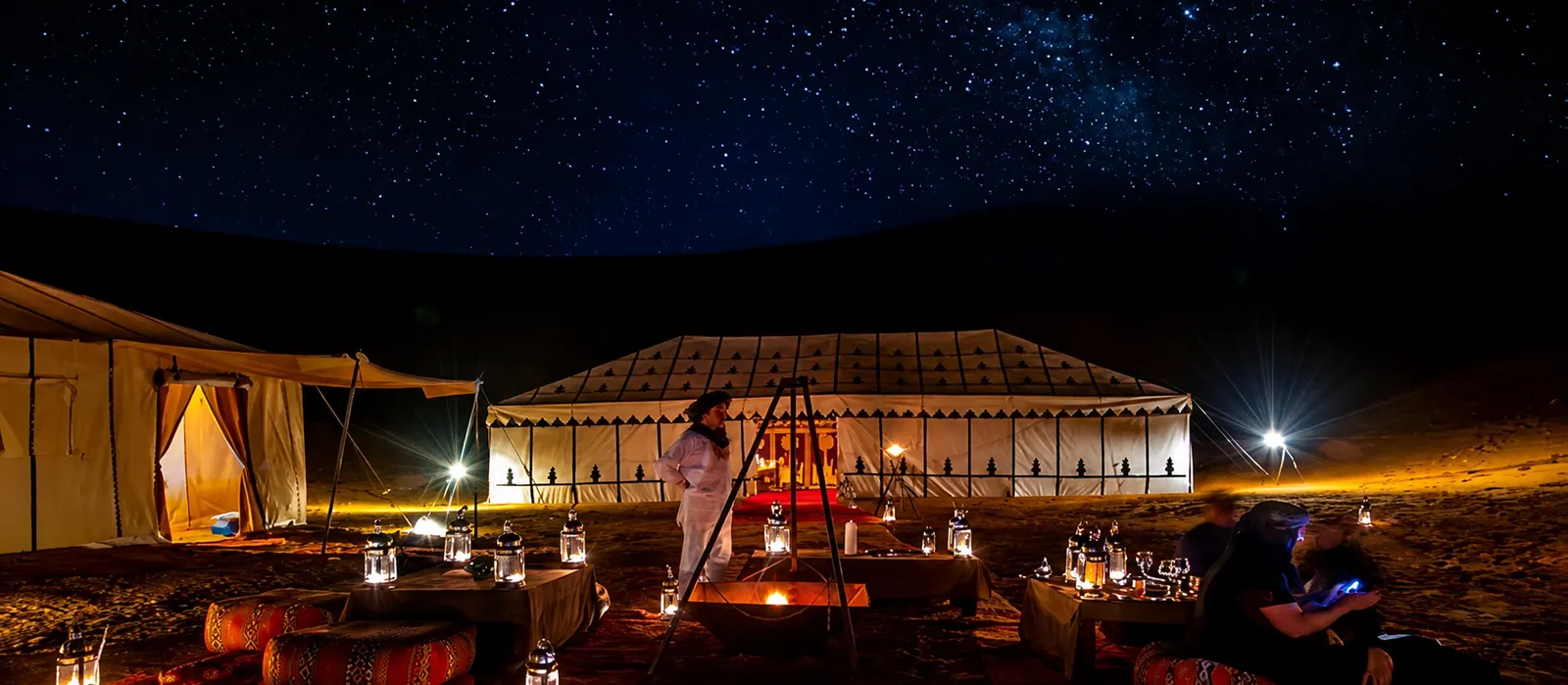
A second sunset and a second night under the stars. The second night is usually quieter than the first — less excitement, more genuine rest. People who have been moving constantly for four days often find that the desert is the first place they have actually stopped.
“The first night in the desert, people are still tourists. The second night, they are just there.”
Day 6: Todra Gorge and the long road back
We leave Merzouga in the morning and drive northwest to the Todra Gorge — a canyon where the walls narrow to fifteen metres at the base and rise over 300 metres on either side. It is a genuinely dramatic piece of landscape. Rock climbers come from across Europe for the walls. Even for those who do not climb, the walk up the gorge floor, in the cool of the canyon, is something between meditation and awe.
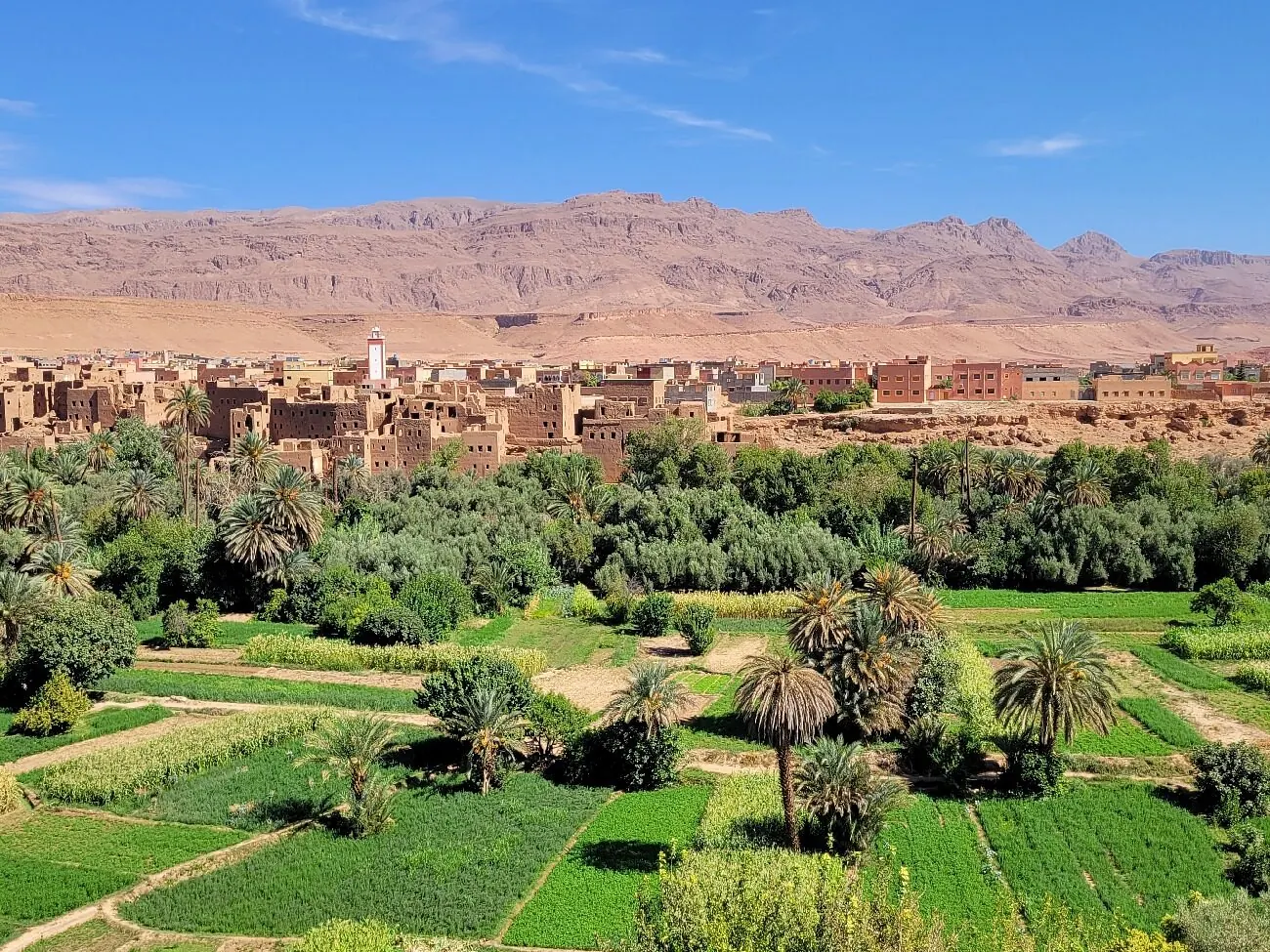
Beyond Todra, the road continues through Tinghir and into the Ziz Valley — a long, improbable ribbon of date palm oasis following the course of the Ziz river through the stone desert. Villages of mud brick and palm wood appear and disappear. The light in the late afternoon is the colour of amber.
We stop for dinner in Erfoud — a quiet, authentic southern Moroccan town that most tourists drive straight through — before reaching our accommodation in the Errachidia region for the night.
Day 7: Return to Marrakech
The return route north takes a different line through the Atlas — through the cedar forests of Azrou if time allows, or through the Ziz gorge and back over the mountains via a different pass. The drive is long but the landscape continues to give.
We arrive in Marrakech in the early evening. Some travellers want to return immediately to the medina for one last dinner. Others want a quiet meal and an early departure. We adapt. The city, having been the beginning, now reads differently — its chaos familiar, its beauty already half-remembered.
What luxury means on this itinerary
Luxury in Morocco is not the same as luxury in European hotels. The best riads in the medina are not large — they are precise: the quality of the food, the thread count of the linen, the attentiveness of a small staff who know your preferences by the second morning. In the desert, luxury is a proper bed, a private bathroom with running water, and a camp positioned for a genuine horizon view. Along the route, it is accommodation in family-run guesthouses where dinner is cooked to order and breakfast appears without being asked.
On all our journeys, transportation is private — a modern 4x4 with air conditioning. Your guide speaks English and knows the route intimately: not the brochure version, but the real version, including which lunch stop is worth the detour and which roadside attraction is better admired from the car.
Variations: if you have more or less time
Five days: Compress by combining Days 3 and 4 into a single long driving day and spending only one night in the desert. You lose depth but gain the essential experience. Recommended only for travellers who are genuinely comfortable with long drives.
Ten days: Extend by adding two nights in Fes — the most complex and rewarding medina in North Africa — at the beginning or end of the journey, and adding the Ouzoud Waterfalls or Essaouira on the coast to the final day. Ten days gives Morocco the space it deserves.
Twelve to fifteen days: This is where Morocco begins to reveal itself fully. We add the north — Chefchaouen in the Rif Mountains, the Roman ruins at Volubilis, the Atlantic coast — to create what is, in my view, the most complete possible first encounter with the country.
“Every version of this journey ends the same way: people in the back of the car, quiet, looking out the window. Not at their phones. At Morocco.”
Want a different rhythm? Compare 2, 3 and 4 day desert tours, or see the full 8 day Morocco tour from Casablanca.