The first rule of the Fes medina is to stop trying to navigate it. Fes el-Bali has approximately nine thousand alleys. No cars can enter — the streets are too narrow, and in many places you could touch both walls simultaneously. The map on your phone is more or less useless. Getting lost is not a risk. It is the experience.
Fes is the oldest of Morocco's imperial cities, founded in 789 AD and continuously inhabited since. It is also the most complex. Marrakech has grandeur and energy and a legible geometry; Fes has depth. The medina layers itself vertically and horizontally — tannery workers below, madrasa students above, spice merchants on one side of a wall and silversmiths on the other, the whole thing functioning with a logic that reveals itself slowly, across days, not hours.
Most travellers who spend a full day in Fes leave understanding almost nothing of the city, and feeling the richer for it. It is that kind of place.
Two cities, not one
The name 'Fes' refers to several overlapping things. Fes el-Bali — Old Fes — is the medieval medina, the UNESCO World Heritage site, the place with nine thousand alleys and no cars. Fes el-Jdid — New Fes — was built in the thirteenth century as an administrative annex; it is now home to the royal palace and, beside it, the Jewish Mellah, one of the oldest in North Africa. And then there is the modern city, the Ville Nouvelle, which the French built a kilometre away when they decided that the medina was too dense to alter and too important to destroy.
Most visitors spend their time in Fes el-Bali, which is correct. But the ten minutes it takes to walk through the Mellah — past the distinctive wrought-iron balconies, the Hebrew lettering still visible on some doorframes, the market that now sells both Moroccan and Jewish-influenced food — adds a layer of history that the medina alone cannot give.
The tanneries: what the experience actually is
The Chouara tanneries are the most photographed sight in Fes. From above — from the terraces of the surrounding leather shops — you look down into a honeycomb of circular stone vats filled with dye: ochre, indigo, poppy red, white lime, brown walnut. Workers stand knee-deep in the vats, treading hides with bare feet. The leather is then stretched to dry on the surrounding rooftops.
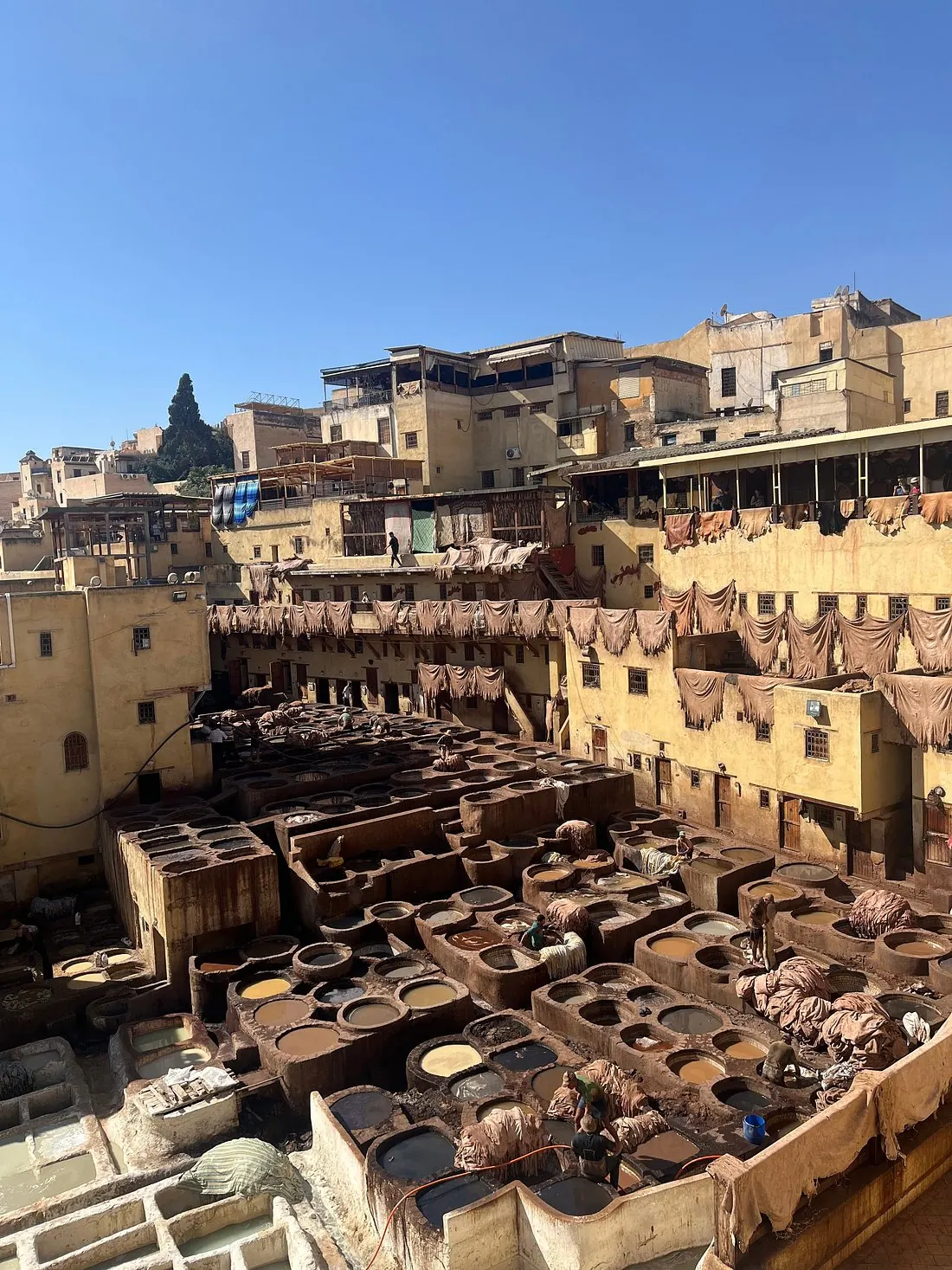
The shop owners offer you a sprig of mint to hold against your nose. You will need it. The smell of the tanneries — pigeon dung, quicklime, and the particular chemistry of raw hide in various stages of processing — is genuine and strong. This is not a reconstruction or a demonstration. It is a working tannery that has operated, on this site, since the eleventh century.
The workers are paid piece-rate, the craft knowledge is passed between families across generations, and the leather of Fes is still considered some of the finest in the world for hand-stitched bags, slippers, and belts. When you buy leather in Fes, you are buying something made by hand in a facility that predates most of European architecture. This is worth knowing before you bargain the price down to nothing.
The Bou Inania Madrasa: the finest room in Morocco
A madrasa is a Quranic school — a residential college for religious studies. The Bou Inania, built in the mid-fourteenth century under the Marinid Sultan Bou Inan, is the most elaborate in Morocco and, in my view, the finest piece of interior architecture in the country. This is not hyperbole. It is a room — a courtyard, properly — that people stand in without speaking.
The lower walls are covered in geometric zellige tilework in eight colours. Above the tiles, carved plaster panels rise in extraordinary detail: arabesque, calligraphic inscriptions, geometric patterns whose complexity deepens the longer you look. Above the plaster, carved cedarwood screens and balconies mark the former student quarters. The whole composition rises around a marble fountain and a central basin of still water that reflects the arcade above.
It is open to non-Muslim visitors. Come in the morning before the tour groups arrive. Stand near the basin. Look up. That is the visit.
Moving through the medina: practical notes
The nine thousand alleys of Fes el-Bali are loosely organised by trade, as they have been for centuries. The metalworkers occupy one quarter; the leatherworkers another; the fabric merchants, the wood turners, the spice sellers each have their districts. The organization is imperfect and evolving, but orientation comes gradually as you learn the adjacencies.
Mules are the primary mode of goods transport in the medina. You will share the alleys with them regularly — loaded with propane tanks, food deliveries, rolls of leather, construction materials. The procedure is simple: step aside and let them pass. They know where they are going and they are in a hurry.
“The medina of Fes is the largest car-free urban area in the world. What sounds like a restriction is actually a liberation. Without the noise and danger of traffic, the city returns to human scale — and you can hear the craftsmen working two alleys away.”
Disorientation is not a problem to be solved. Every alley in the medina eventually leads somewhere. The medina is bounded — there are gates on all sides — so you cannot walk out of Morocco by accident. If you need to find your way back, walk uphill to the city walls and follow them to the nearest gate. But allow yourself to be lost first. The best things in Fes are found in the detours.
Morning in the medina
The medina works best early. The craftsmen begin their day around seven. The bakeries put bread in the wood-fired ovens before dawn, and the smell of it drifts through the alleys until mid-morning. The light at eight in the morning, filtered through the narrow gap between buildings four storeys high on either side, falls in golden shafts onto the cobblestones.
By ten, the main tourist circuits are busy. By noon, the tannery terraces are crowded. The afternoon — hot, dense, the souks at maximum volume — is the hardest time in the medina. The early evening, as the workshops close and the light changes and the call to prayer echoes from the minarets across the rooftops, is the second best time of day.
The food of Fes
Morocco has a culinary tradition that is more sophisticated and regionally varied than most international visitors expect. Within that tradition, the cooking of Fes is widely considered the most refined. The city's aristocratic history — it was Morocco's political and cultural capital for long stretches of the past millennium — produced a cuisine that values technique, patience, and layered flavour over spectacle.
Bastilla is the dish to seek: a large round pie with a crisp pastry crust filled traditionally with pigeon or chicken, almond, egg, and a careful balance of cinnamon and icing sugar. The combination sounds unlikely. It is extraordinary. The preparation takes hours. A good bastilla in Fes is the result of a cook who learned the dish from her mother, who learned it from hers.
The medina has restaurants whose tables are in a back courtyard, invisible from the alley. You find them by following someone who knows them. We do this on our guided days in Fes — lunch in a place with no sign on the door, where the fixed menu changes daily and the tea comes without being ordered.
Staying inside the medina
The riads of Fes — the traditional courtyard houses converted to guesthouses — are among the most interesting places to sleep in Morocco. A good riad in Fes is typically in a building that is several hundred years old: thick walls that keep the rooms cool in summer, internal courtyards that funnel air between the floors, zellige tilework that has been in place since the Ottoman period. The exterior gives nothing away — an unmarked door in an alley, indistinguishable from a private residence. Inside is quiet, even when the medina directly beyond the door is anything but.
Staying inside the medina rather than in the Ville Nouvelle changes the experience of Fes entirely. You wake to the call to prayer rather than traffic noise. You walk out of your door directly into the oldest living city in Morocco. The disorientation that was a challenge on the first afternoon becomes, by the second morning, something closer to belonging.
How much time Fes deserves
One day in Fes gives you the highlights. It is not enough. Two days in Fes begins to let the city settle — you recognise streets from the day before, you find the madrasa a second time without consulting anyone, you begin to understand the geography. Three days is the threshold at which Fes stops being a place you are visiting and becomes a place you are inhabiting, however briefly.
On our nine-day Grand Morocco Journey, we spend two full days in Fes. On our longer itineraries, three. In either case, we structure the days differently: the first for orientation and the major sites, the second for deeper exploration and the food, the third — for those who have it — for whatever the city has left to show you, which is always more than you expect.
“Every time I come back to Fes I find something I have not seen before. After more than a decade, that has not changed. The city is too large, and too layered, to be finished.”
Planning your visit? The medina of Fes has been a UNESCO World Heritage Site since 1981. Fes is the natural end point of our 3 day Marrakech to Fes desert tour, and you can also start there with the 4 day Fes to Marrakech desert tour. Before you go, read our Morocco travel tips for first-time visitors.