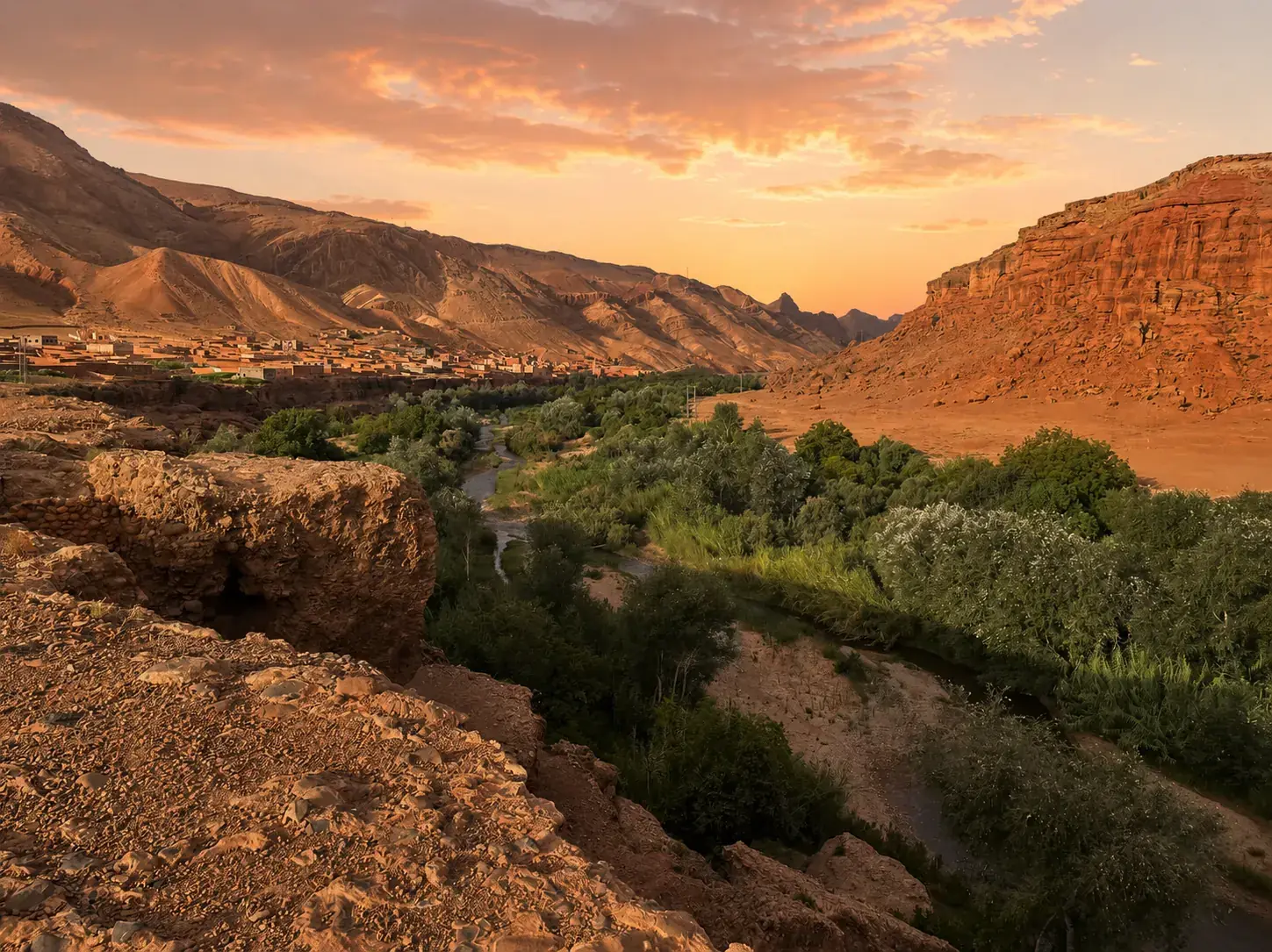
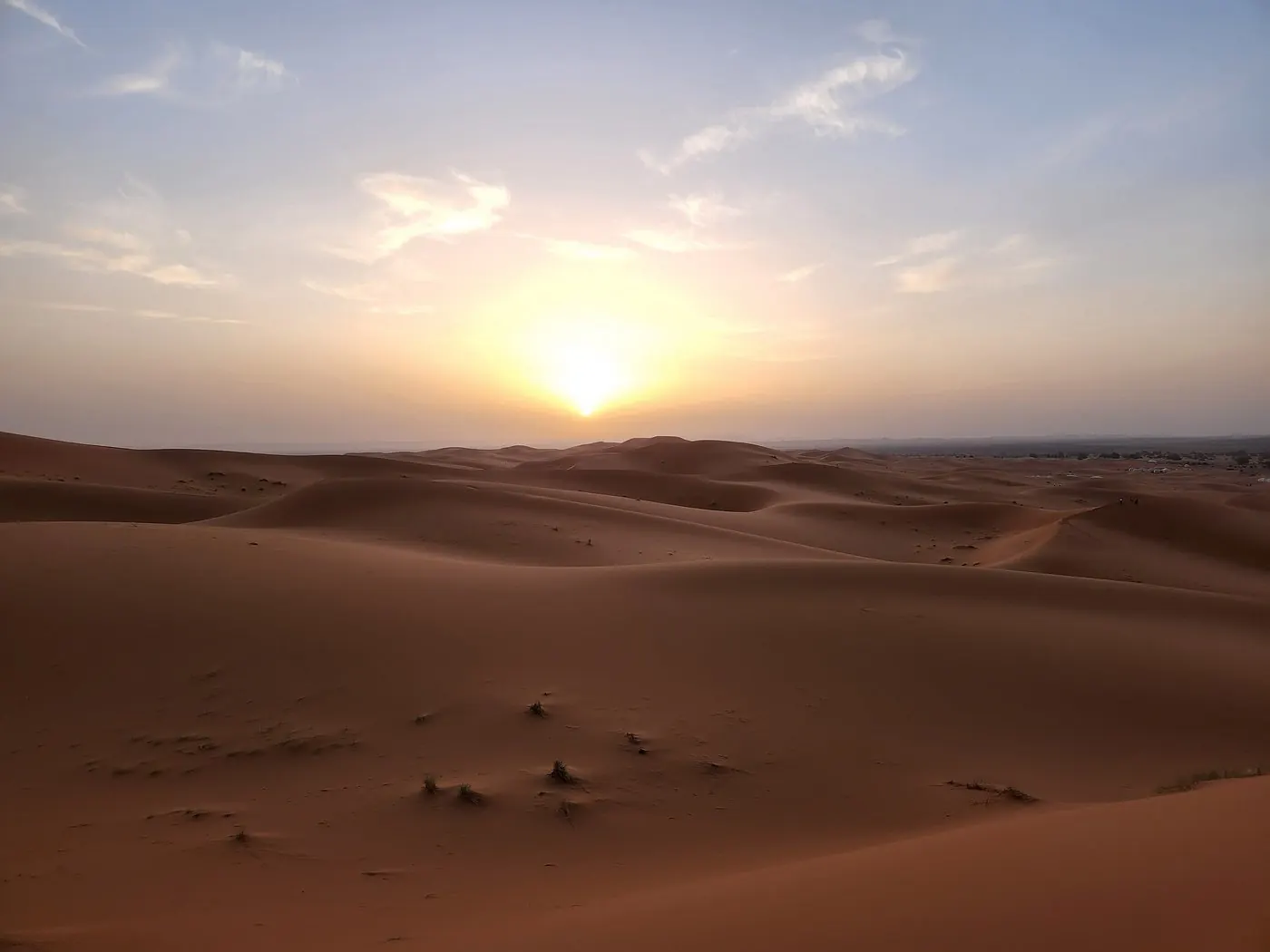
The photographs do not lie about Erg Chebbi — but they cannot tell you what it feels like to stand at the base of a 150-metre dune and understand, for the first time, what silence actually means.
Merzouga is a small Berber village at the edge of the largest sand sea in Morocco. For most of the year it is a quiet place — a scattering of guesthouses, a few palm trees, a road that simply ends where the dunes begin. But the dunes themselves, the great orange wave of Erg Chebbi, are one of the most arresting landscapes on earth. I have guided travellers into this desert for more than a decade, and the moment they first see it — the moment the road opens and the dunes rise — still stops me.
What Erg Chebbi is, exactly
Not all desert is the same. Much of Morocco's interior is rocky desert — the hammada, a vast flat expanse of stone and gravel that is ancient and beautiful in its own way. Erg Chebbi is something different. An erg is a sea of sand, shaped by wind into dunes that rise and shift and take on a different colour every hour of the day. Erg Chebbi is roughly 22 kilometres long and 5 kilometres wide at its broadest point. The highest dunes reach 150 metres.
The sand is not the pale beige of a beach. It is mineral-rich, ranging from pale gold in the midday sun to deep amber at dusk to something close to rose in the last light of evening. The colours are not an effect of photography — they are what you actually see.
Getting to Merzouga: distances and honest drive times
Merzouga sits in the far south-east of Morocco, close to the Algerian border. There is no train connection and no reliable bus service that a reasonable person would choose. The journey is by road, and this is not a brief one.
- From Marrakech: approximately 560 kilometres via the Tizi n'Tichka mountain pass and Ouarzazate — allow nine to ten hours of driving, or a comfortable two-day journey. The two-day route, stopping to sleep in the Dadès Gorge, is far superior to pushing through in one day.
- From Fes: approximately 560 kilometres via Midelt and Errachidia — six to seven hours of driving. The Fes-to-Merzouga route passes through a dramatically different Morocco: cedar forests, the Ziz Valley palm oasis, a landscape that few international travellers see.
- From Ouarzazate: approximately 300 kilometres — four to five hours, passing through the Rose Valley and the village of Rissani.
The drives are not simply functional. The road between Marrakech and Merzouga passes through some of the most varied landscape in North Africa. If you treat the journey as part of the experience rather than the inconvenience before it, something opens up.

When to go: the seasons in the Sahara
The best seasons for Erg Chebbi are October through November and March through May. During these months, daytime temperatures in the desert area reach twenty-five to thirty-two degrees — warm and golden, comfortable for walking the dunes and riding camels in the afternoon. Nights cool significantly: expect ten to fifteen degrees in the shoulder seasons, and as low as three or four degrees in January.
Summer in the deep Sahara — June through September — is genuinely challenging. Temperatures exceed forty-five degrees in July and August. The camps are equipped with air conditioning, but the midday dune experience is best avoided. If summer is your only option, we restructure the desert day: camel trek at five in the morning, sunrise on the dunes, back to camp before nine.
Winter (December through February) is, in my view, underrated. The days are mild and luminously clear. The nights are cold — sometimes very cold — but the camps are built for this, and the winter sky over Erg Chebbi is extraordinary. The Milky Way, in December, is clearer than at any other time of year.
What happens when you arrive: the rhythm of a desert day
We time the arrival at Merzouga for late afternoon. This is deliberate. The heat has softened. The dunes have turned from pale gold to amber. You change into looser clothing, leave most of your bags at the desert edge, and mount your camel.
The trek into the dunes takes between thirty and fifty minutes, depending on the camp location. The pace is slow — camels move at their own rhythm, and attempting to hurry them is counterproductive in every sense. You ride in single file, your shadow stretching long across the sand, the silence interrupted only by the soft footfall of the animals and the occasional creak of the saddle.
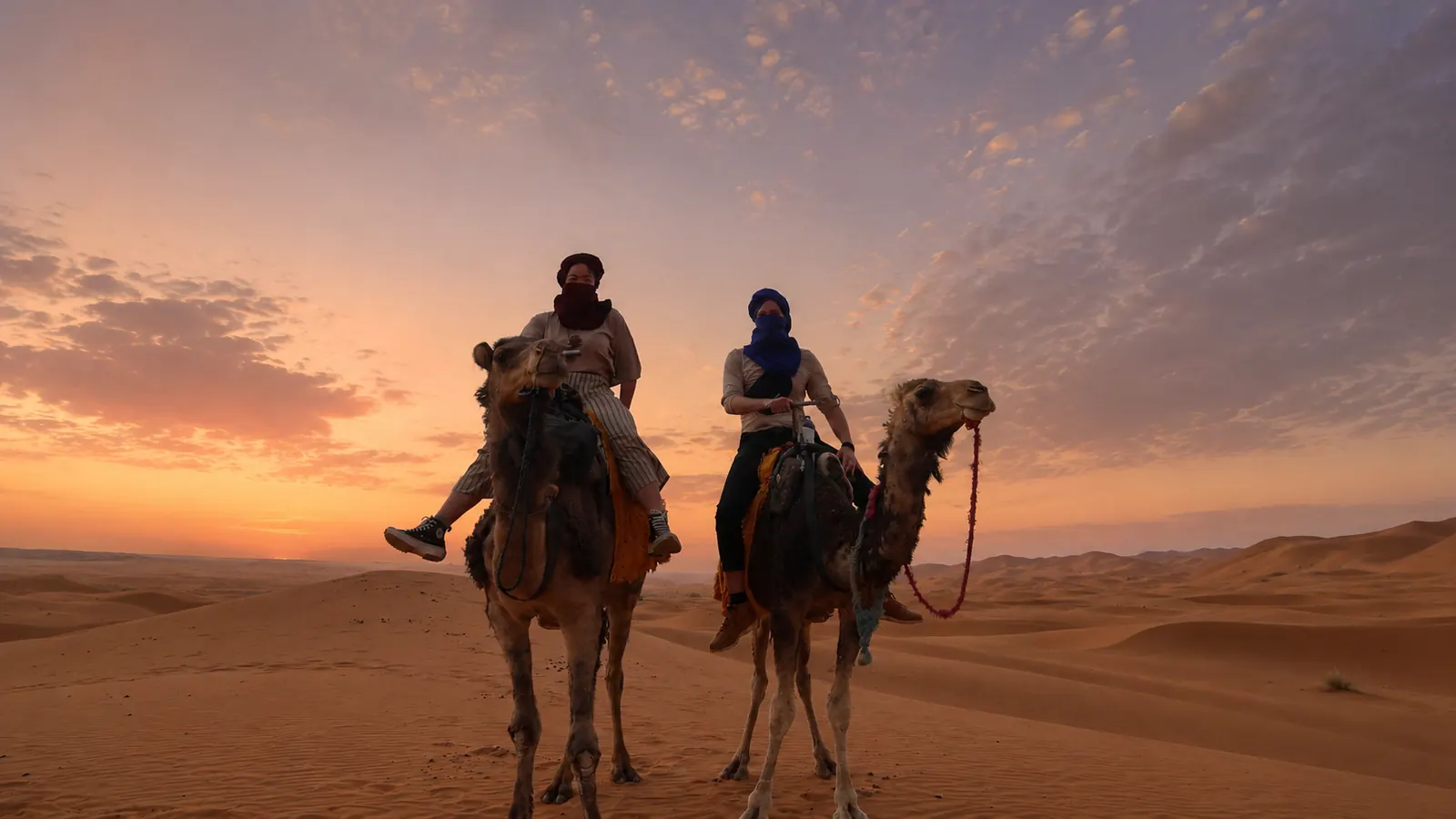
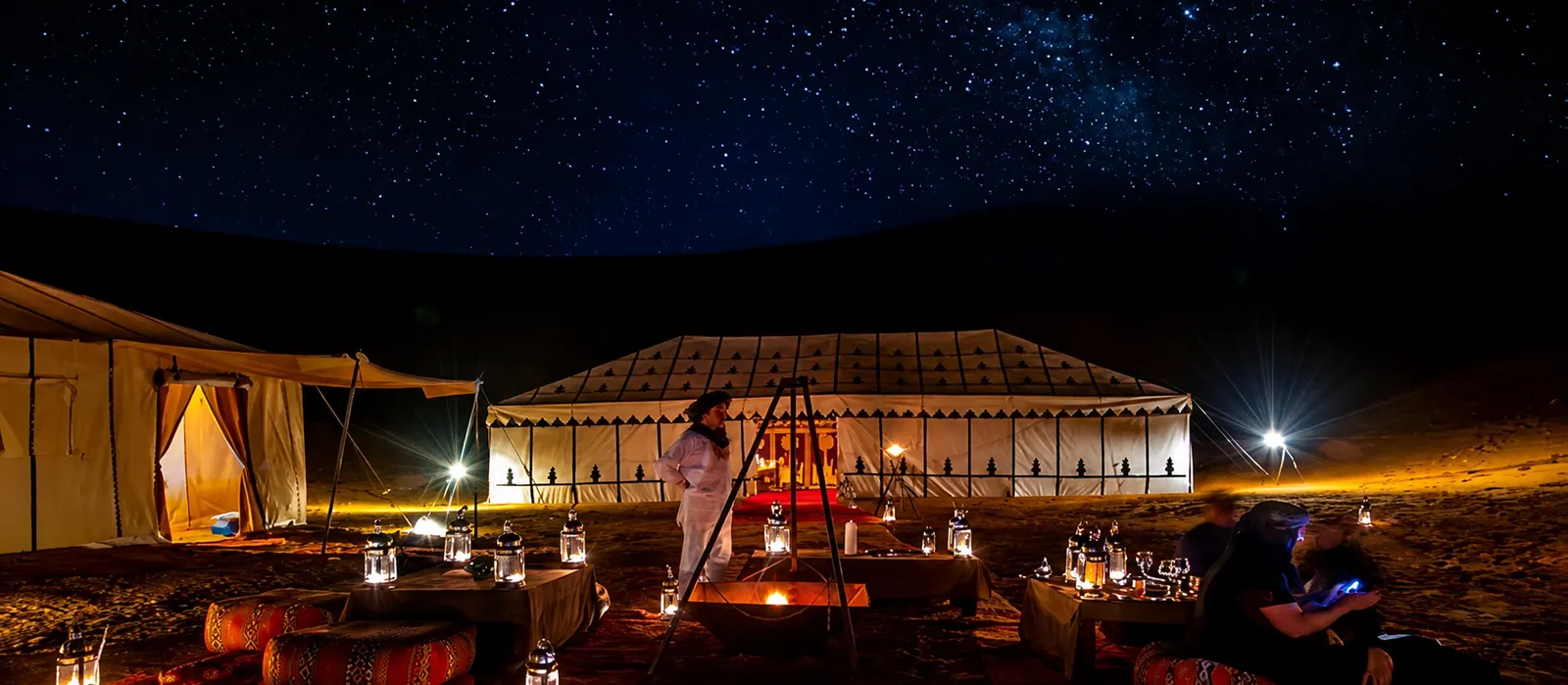
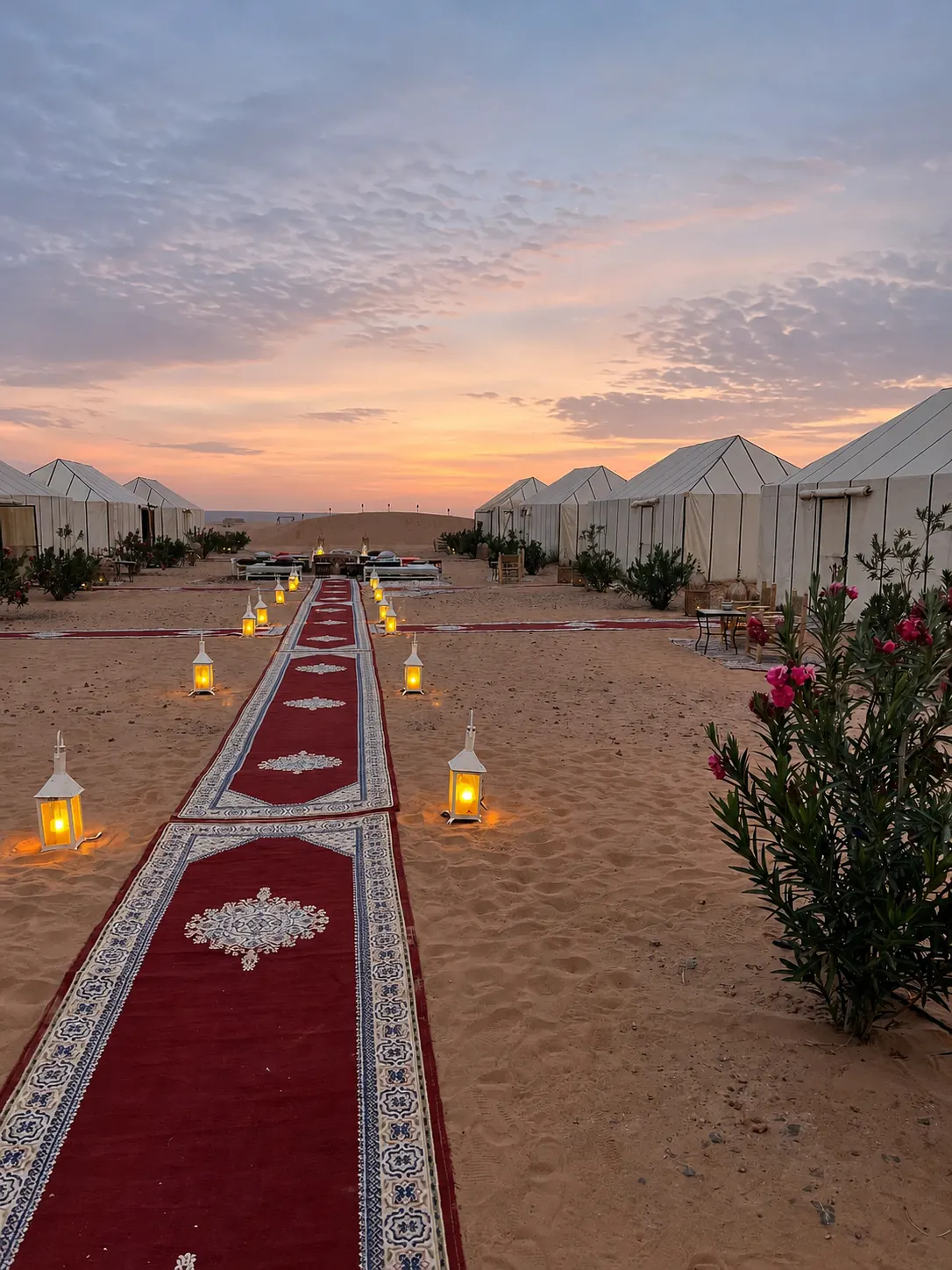
Arriving at camp as the last light leaves the dunes is one of the few travel experiences that consistently exceeds expectation. Lanterns have been lit. Dinner is being prepared. Musicians are warming up near the fire. You drop your bags in a tent and walk to the nearest ridgeline to watch the stars appear.
“The most important thing to do in the Sahara is nothing. Sit on the dune. Let the silence come to you. It takes about twenty minutes — and then it arrives, and you understand why people come back.”
Dinner in the camp is communal — tagine cooked over fire, bread baked in the sand, mint tea poured from a height in the traditional way. Berber music — drums and guembri and the handclapping rhythms of desert folk songs — plays around the fire. The nights are long and unhurried.
Sunrise on the dunes: why we wake everyone early
We wake guests before sunrise. Some resist. None have ever been disappointed. The cold just before dawn is sharp — you will want the warm layer you packed. But the walk up the dune before first light, in complete darkness, is disorienting in the best way: you cannot see the scale of what surrounds you until the sun cracks the eastern horizon.
When the light comes, it comes slowly. The ridgelines turn pink first, then gold, then the full amber of the dunes catches and the desert warms in visible stages. It takes perhaps twenty minutes from first light to full sunrise. Those twenty minutes are the reason people tell us, years later, that the Sahara was the most beautiful thing they have ever seen.
What to pack: specific advice from the desert
This is not a generic packing list. It is what I actually tell people before they get in the car.
- A warm layer for the dune walk. Even in October, two in the morning is genuinely cold. A fleece or down jacket that compresses into your day bag.
- Closed shoes for the dune walk at night and at sunrise — not sandals. Sand at four in the morning is cold, and the walk is steep enough to need grip.
- Sunscreen that you will actually use. The desert reflects heat from the sand as well as receiving it from above. The burn rate is higher than you expect.
- A headlamp or torch. Camps are lantern-lit and beautiful, but navigating between tents at midnight requires light.
- Loose, light-coloured cotton for the daytime hours. Synthetic fabrics trap heat in ways that become unpleasant quickly.
- Leave your largest bags at the camp edge or in the vehicle. You carry only what you need for one night. Everything else waits.
- Your phone, fully charged — but consider leaving it in the tent. The photographs you take of the Milky Way will not look like what you saw. The memory of having looked will.
What luxury means in the desert
There is a wide range of accommodation at the edge of Erg Chebbi, from basic tents to what are now described as luxury camps. The distinction matters. Our camps have proper beds — not sleeping bags on mats — with linen, comfortable mattresses, and individual bathrooms with running water and, in cooler months, heating. The tents are spacious. The facilities are maintained.
The better desert experiences are not about extra amenities. They are about thoughtful design: camps positioned for a genuine horizon view rather than a view of the next tent, fire pits that create real warmth rather than performative ambience, guides who know the dunes well enough to take you to the quieter ridgelines away from other groups. These are the things that distinguish a memorable night in the desert from a disappointing one.
Around Merzouga: beyond the dunes
Most travellers arrive in Merzouga, walk the dunes, sleep, and leave. This is understandable — the dunes are why people come. But the area rewards a second day. The village of Khamlia, a few kilometres from Merzouga, is home to a community of Gnawa musicians — descendants of sub-Saharan traders whose music is unlike anything else in Morocco. Small, informal performances happen most evenings, and the welcome is genuine.
The fossil beds south of Merzouga contain trilobites and ancient marine fossils from when this part of the Sahara was an inland sea. Watching a local craftsman work the stone while explaining what he has found — creatures that lived here 350 million years ago — is a perspective shift of its own kind.
The road toward the Algerian border, though we do not cross it, offers some of the most cinematic driving in southern Morocco. Mud-brick villages in shades of rose and terracotta. Date palms following the course of the ancient river. The flat silence of the open erg.
Common questions from travellers planning their first Sahara visit
How many days do you need in Merzouga? One night is the minimum that makes the drive worthwhile. Two nights allows you to see the dunes in different light and at a slower pace. Three nights is the threshold at which people stop rushing and start actually resting. We design our desert itineraries around at least two nights, often integrated into longer Morocco journeys.
Is it worth visiting if you have a fear of heights? The dunes are steep but not technical. Most people who are cautious about heights find that the open, gradual slope of the dunes is different from a cliff or a building. There are no sudden drops. You move at your own pace. In ten years, I have not had a single traveller who regretted attempting the dunes.
Can I visit without riding a camel? Absolutely. The camel trek is the most common way to arrive at camp, but it is not compulsory. We have walked the route with families with young children, with guests who preferred to travel on foot, and with people who simply wanted to move slowly. The walk takes longer but the experience is its own.
“There is no right way to meet the desert. There is only your way — and the desert is patient.”
Still planning? Our route guide from Marrakech to Merzouga breaks down every stage of the drive, and Agafay vs Merzouga explains why the long road is worth it.