The classic Marrakech to Fes desert tour crosses almost the whole of Morocco in a single journey. You start in the Red City, go over the High Atlas, follow the valley of a thousand kasbahs to the Sahara, spend a night in the dunes of Erg Chebbi, then turn north through the Middle Atlas to the oldest imperial city in the country. Nothing is driven twice, and every day looks completely different from the one before.
This guide explains how the route works, how far you actually drive each day, what is worth stopping for, and how to choose between three, four and five days.
The short answer: the route covers roughly 1,000 km of road over three days at the minimum: Marrakech to the Dades Valley, the Dades to the Merzouga dunes, then Merzouga to Fes. Three days works for travellers who enjoy road trips. Four or five days give you time to walk in the gorges and enjoy the desert without rushing, and are the version we recommend for families and older travellers.
The route at a glance
Distances and times below are approximate and do not include stops. In practice, with photo stops, lunch and visits, each of the three days is a full day on the road.
| Stage | Approx. distance | Approx. driving time | Highlights |
|---|---|---|---|
| Marrakech → Dades Valley | 320 km | 6–7 hours | Tizi n'Tichka pass, Telouet, Ait Ben Haddou, Ouarzazate, Rose Valley |
| Dades Valley → Merzouga | 240 km | 4–5 hours | Todra Gorge, Tinghir palm grove, Erfoud, sunset camel ride |
| Merzouga → Fes | 460 km | 7–8 hours | Sunrise on the dunes, Ziz Valley, Midelt, cedar forest of Azrou, Ifrane |
If you are only interested in the southern half of the trip, our Marrakech to Merzouga route guide covers the road to the dunes in more detail.
Day 1: Marrakech to the Dades Valley
Over the High Atlas
Leave Marrakech early. Within an hour the road starts climbing through walnut trees and Berber villages towards the Tizi n'Tichka, the main pass over the High Atlas at around 2,260 metres. In winter the top can be white with snow; in spring the slopes below are green and terraced.
Telouet and Ait Ben Haddou
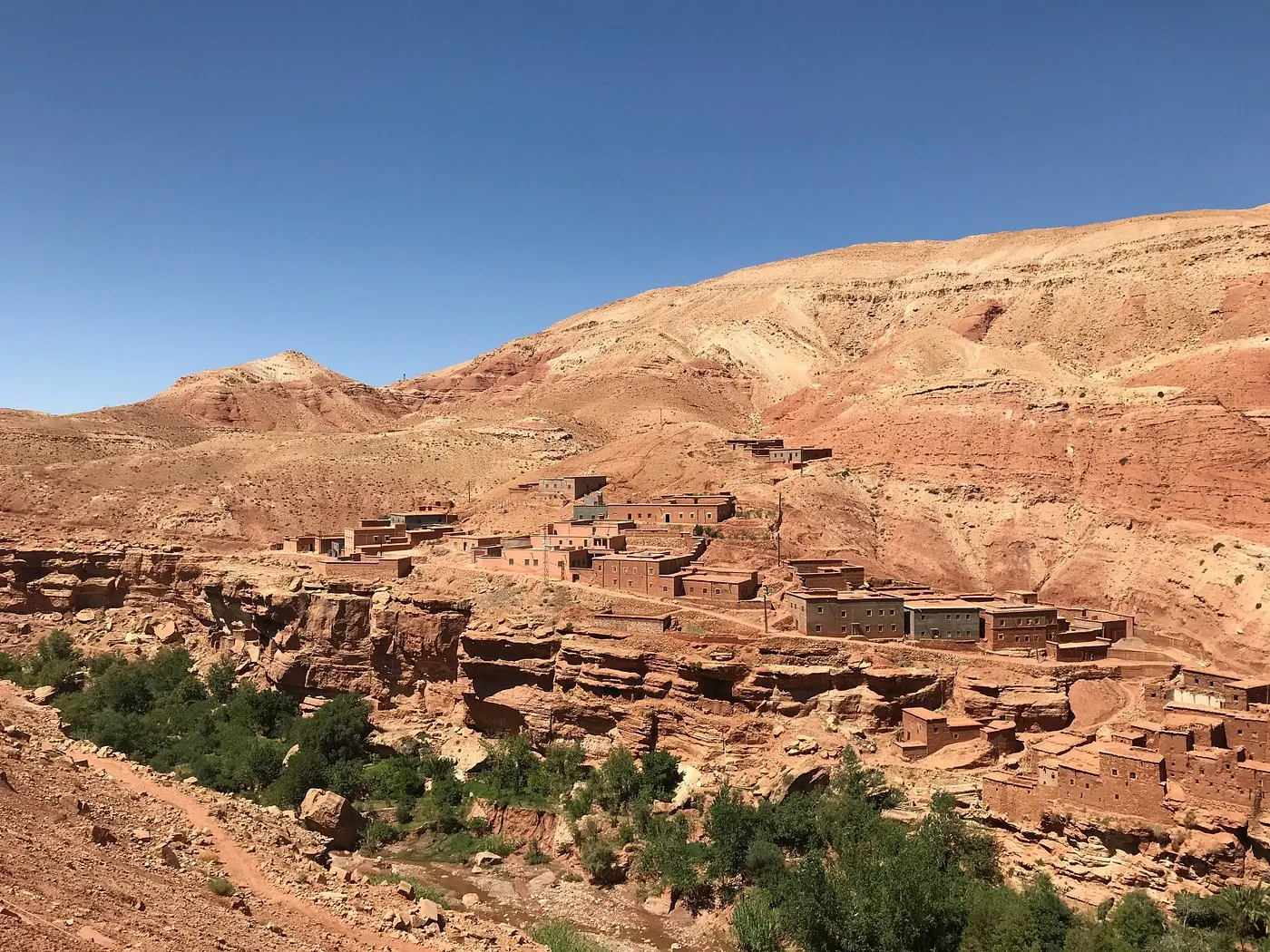
On the southern side, a smaller road leads to the kasbah of Telouet, the former seat of the powerful Glaoui family, whose painted reception rooms are a surprise behind the crumbling earthen walls. The road then follows the Ounila Valley down to Ait Ben Haddou, the UNESCO-listed ksar seen in films such as Gladiator and in the series Game of Thrones. Allow at least an hour to walk up to the granary at the top. Our Ait Ben Haddou guide explains how to see more than the postcard view.
Ouarzazate, Skoura and the Rose Valley
After Ouarzazate, the road runs east along the Dades river through the palm oasis of Skoura and Kelaat M'Gouna, the town of the Rose Valley. The usual overnight stop is in the Dades Valley or at the entrance of the Dades Gorge, where the road climbs between red rock formations. See our guide to the Dades and Todra gorges.
Day 2: the Todra Gorge and the Sahara
Tinghir and the Todra Gorge
East of the Dades, the town of Tinghir sits above a long ribbon of palm groves and fields. A short drive north brings you into the Todra Gorge, where the walls narrow to a few metres apart and rise close to 300 metres above the river. A twenty-minute walk through the narrowest section is enough to feel the scale; a longer walk through the Tinghir palm grove is one of the most peaceful hours of the trip.
Towards the dunes
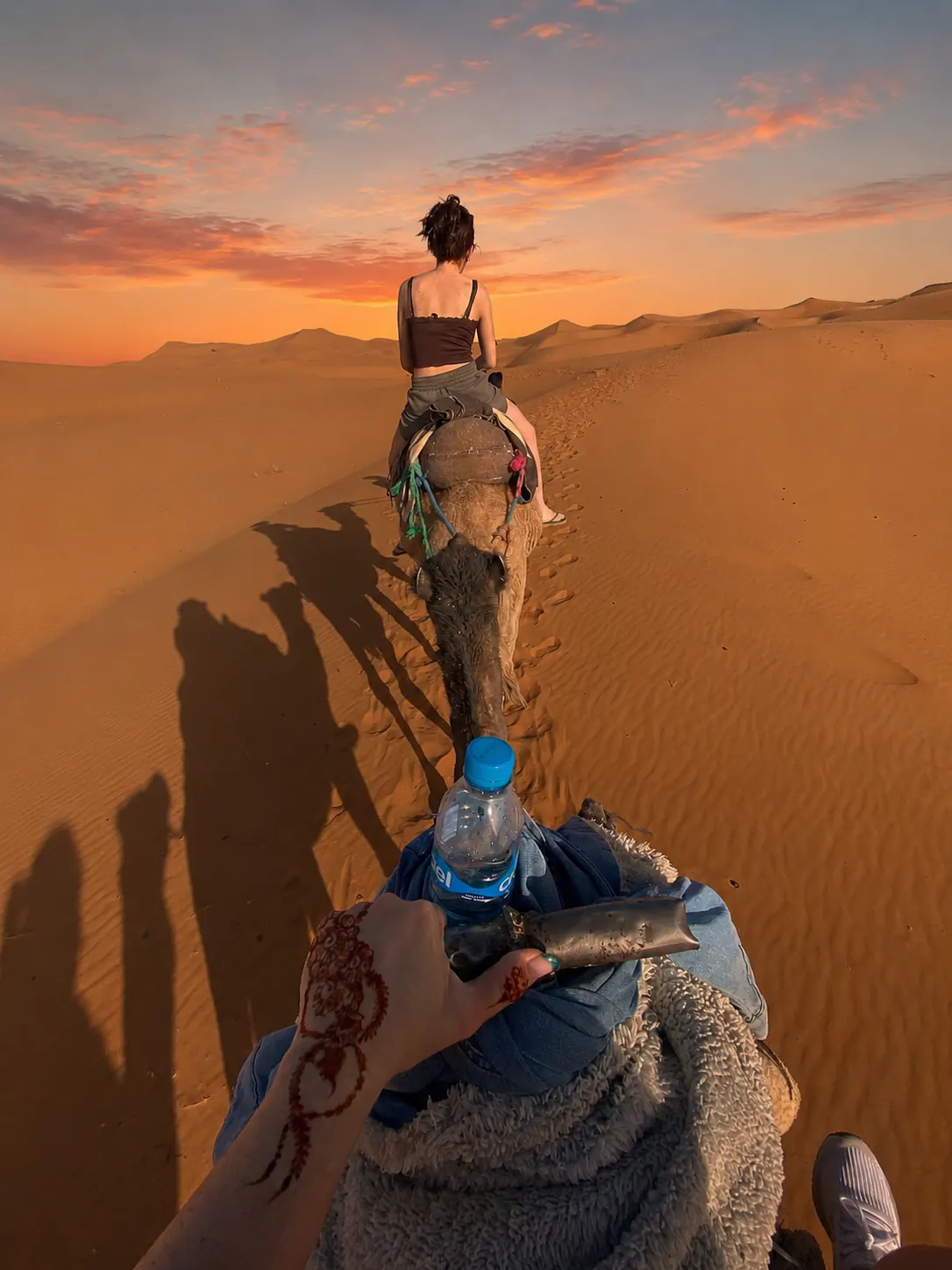
The landscape then opens into flat, stony desert. You pass through Tinjdad and the fossil workshops of Erfoud, on the edge of the Tafilalet oasis, before the orange line of Erg Chebbi appears on the horizon. Timing matters here: the goal is to reach Merzouga in the late afternoon, when the heat has softened, to ride into the dunes at sunset.
A night at Erg Chebbi
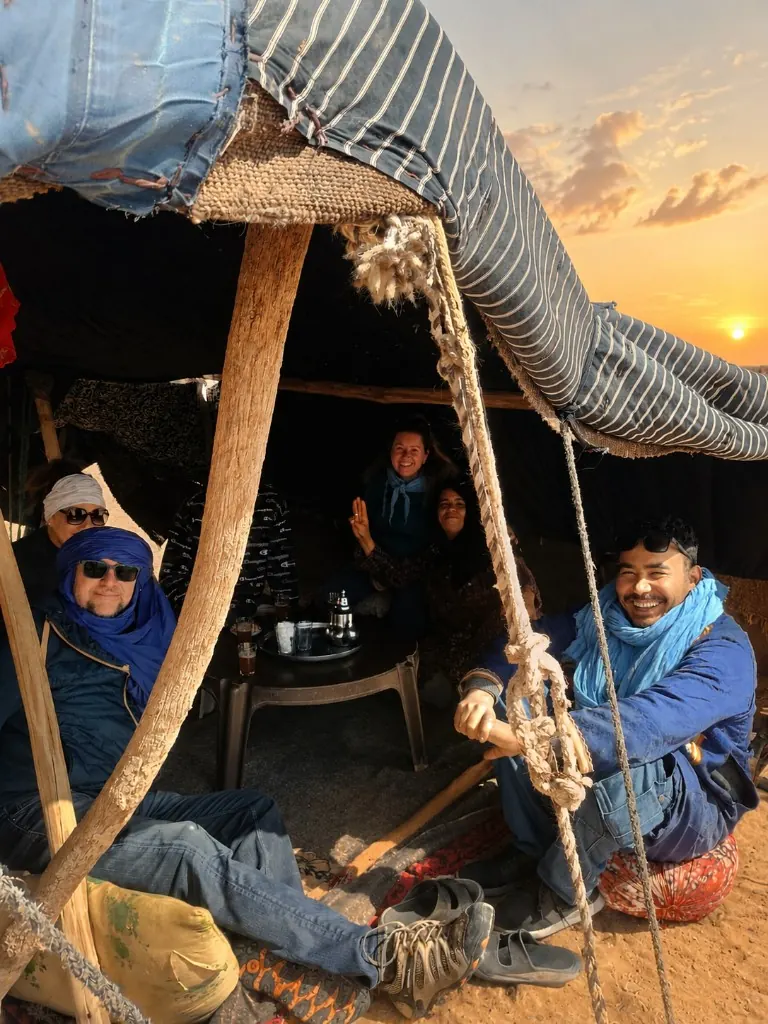
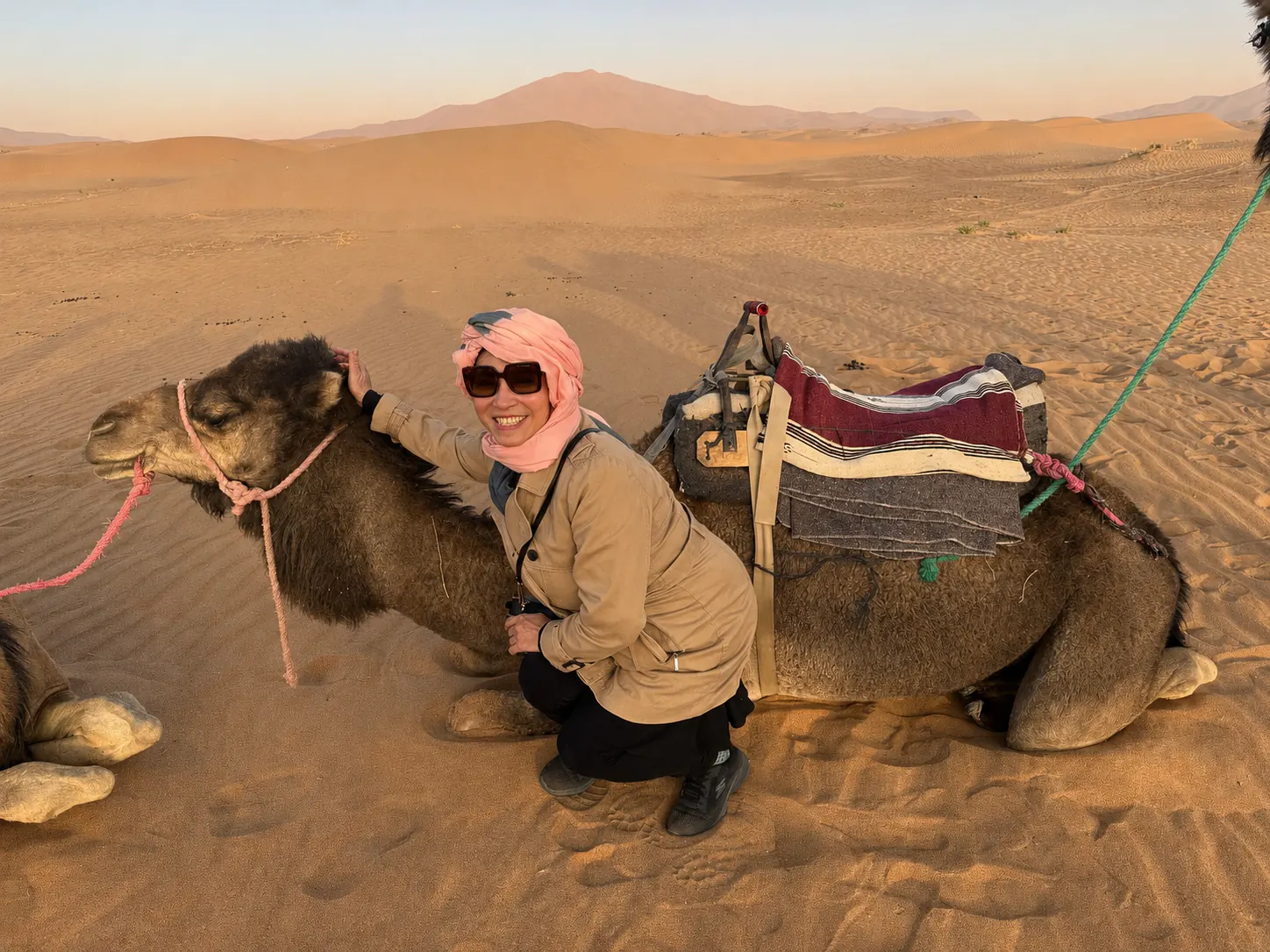
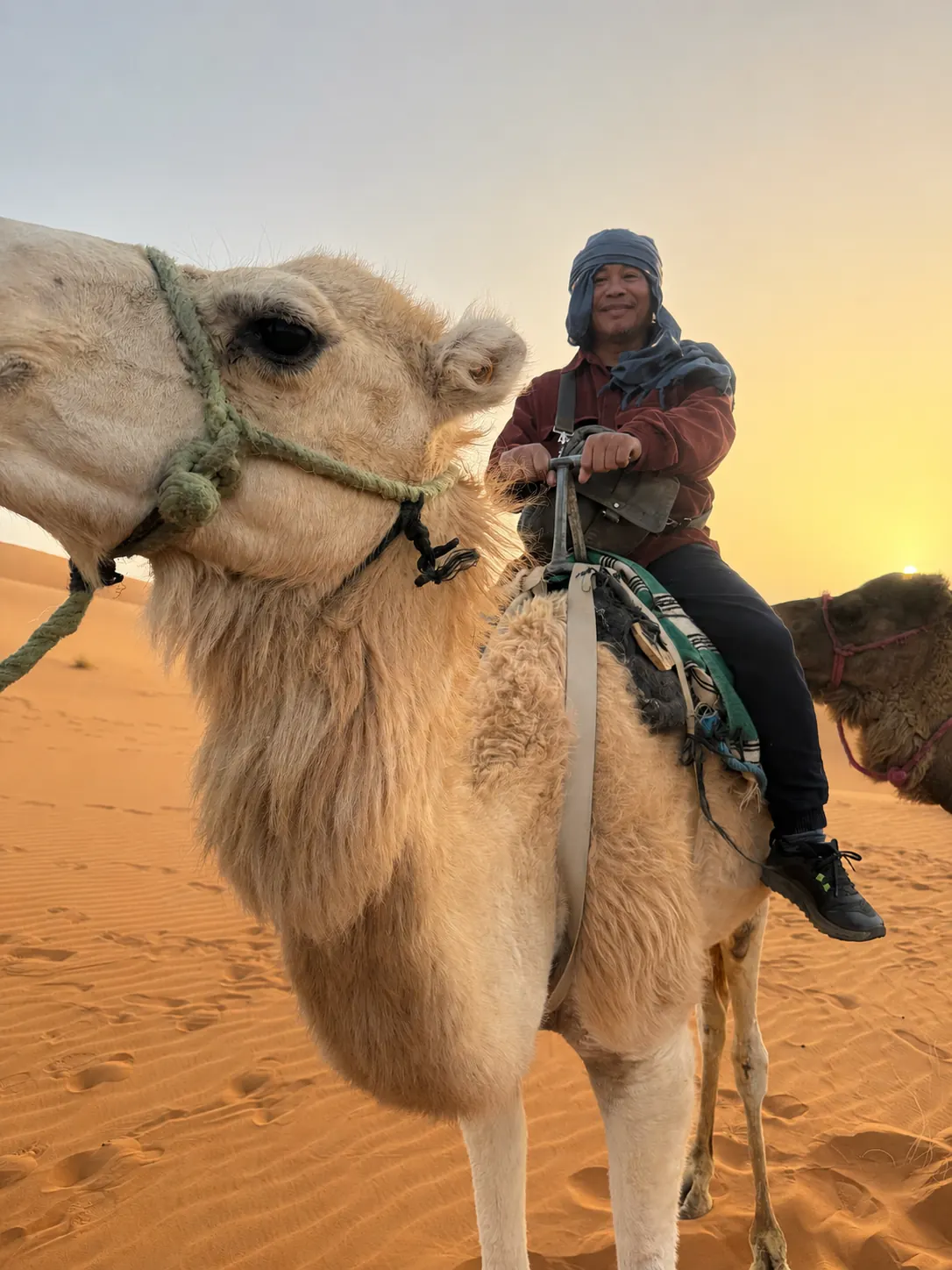
You leave the vehicle and your main luggage at the edge of the dunes, ride a camel to the camp, and spend the evening around dinner, music and one of the clearest night skies in Morocco. To know what to expect, read what a desert camp is really like and our Merzouga and Erg Chebbi guide.
Day 3: Merzouga to Fes
This is the longest day, and the one most travellers underestimate. It is also the day that makes the route special, because the landscape changes completely between morning and evening.
Sunrise and the Ziz Valley
Wake before dawn, climb a dune for the sunrise, then ride back for breakfast. The road north passes Rissani and Erfoud, then follows the Ziz Valley, a deep canyon lined with palm groves and earthen villages. Near Errachidia, the river widens into the reservoir of the Hassan Addakhil dam.
Midelt and the High Atlas plateau
The road climbs over the eastern High Atlas through the Tizi n'Talghemt pass to the high plateau around Midelt, a town known for its apple orchards and dominated by the long ridge of Jbel Ayachi. It is the natural lunch stop of the day.
The cedar forest and Ifrane
After Midelt, the vegetation returns. Around Azrou, the road runs through cedar forests where Barbary macaques, an endangered species native to Morocco and Algeria, are often seen near the roadside. Please do not feed them. A little further, Ifrane looks almost alpine, with sloping roofs and parks, a striking contrast with the dunes you left that morning. You reach Fes in the early evening.
Local tip: the Merzouga to Fes day takes most of the daylight hours. If you have a flight or a dinner reservation in Fes, plan it for the following day rather than the evening of arrival.
3, 4 or 5 days: which Marrakech to Fes tour is right for you?
The route is the same; what changes is how long you spend in the vehicle each day and how much time you have at each stop.
| 3 days | 4 days | 5 days | |
|---|---|---|---|
| Nights | Dades + desert camp | Dades + Todra or Ait Ben Haddou + camp | Two nights in the gorges or two in the desert |
| Driving per day | Long on all three days | More balanced | Comfortable |
| Time in the gorges | Short stops | A real walk | Half a day or more |
| Best for | Road-trip lovers with little time | Most travellers | Families, older travellers, photographers |
Our 3 day Marrakech to Fes desert tour via Merzouga follows exactly the route described above. If you have more time, the 8 day family tour from Marrakech to Fes via the Sahara spreads the same journey over a relaxed week, and the 9 day Morocco tour via Fes and Chefchaouen continues north to the blue city. For a broader comparison of desert tour lengths, read 2, 3 or 4 days? How to choose a desert tour from Marrakech.
Why finishing in Fes is better than returning to Marrakech
Merzouga sits roughly halfway between Marrakech and Fes. A round trip from Marrakech means driving the same mountain road twice. Continuing to Fes costs about the same driving time, shows you a completely different part of Morocco, and leaves you in the city where most itineraries continue anyway, towards Chefchaouen, Meknes, Volubilis or the north coast. Read our guide to the Fes medina to plan your days there.
Doing the route in reverse
If you arrive in Fes, the same journey works the other way round, finishing in Marrakech. See the 3 day Fes to Marrakech tour via Merzouga or the slower 4 day Sahara desert tour from Fes to Marrakech.
Private tour, group tour, bus or self-drive
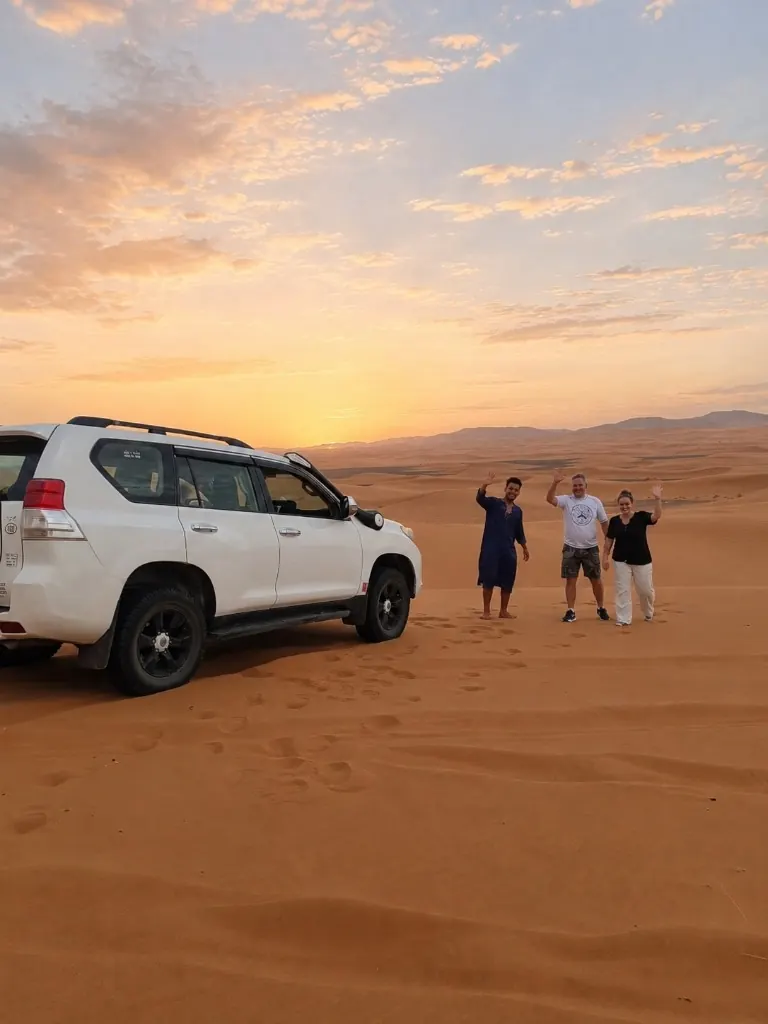
- Private tour with a driver-guide: your own vehicle and schedule, stops where you want, and someone who explains the places you pass. This is the most comfortable way to cover long distances, and the way we run all our journeys.
- Shared group tour: cheaper, but on a fixed timetable, usually in a larger minibus and with a larger camp. We compare both honestly in private or group desert tour.
- Bus: long-distance coaches link Marrakech, Merzouga and Fes, but each leg takes most of a day, and you see the landscape only through the window.
- Self-drive: possible on good roads, but the mountain passes need concentration, and you will need a camp that collects you at the edge of the dunes.
When to go
Spring (March to May) and autumn (September to November) are the most comfortable seasons for this route: warm days in the desert, mild evenings in Fes and clear mountain views. In summer, the desert is very hot in the middle of the day, so camel rides take place at sunset and sunrise. In winter, days are often sunny, but nights in the desert can approach freezing and the passes of the High and Middle Atlas occasionally see snow, so a little flexibility helps. Our month-by-month guide to the best time to visit Morocco has the details.
Practical tips for a Marrakech to Fes desert tour
- Pack a small overnight bag for the desert camp; your main luggage stays in the vehicle. Our desert packing list covers the rest.
- Bring warm layers even in spring and autumn: the desert at night, the Tichka pass and the Middle Atlas are all much cooler than Marrakech.
- Carry small notes in dirhams for coffee stops, tips and village shops.
- If you suffer from car sickness, sit in front and take your medication before the mountain sections, not after.
- Dress modestly for the villages along the way; see what to wear in Morocco.
“Most travellers book this route for the dunes. They usually remember the whole road: the snow on the Atlas, the kasbahs, the cedar forest and the moment Fes appears at the end of the day.”
Ready to cross Morocco from Marrakech to Fes? Discover our 3 day Marrakech to Fes desert tour, browse all our Sahara desert tours and tours from Marrakech, or tell us your dates and we will adapt the route to your pace. You can also reach us on WhatsApp.